The board loses a line between one radio call and the next.
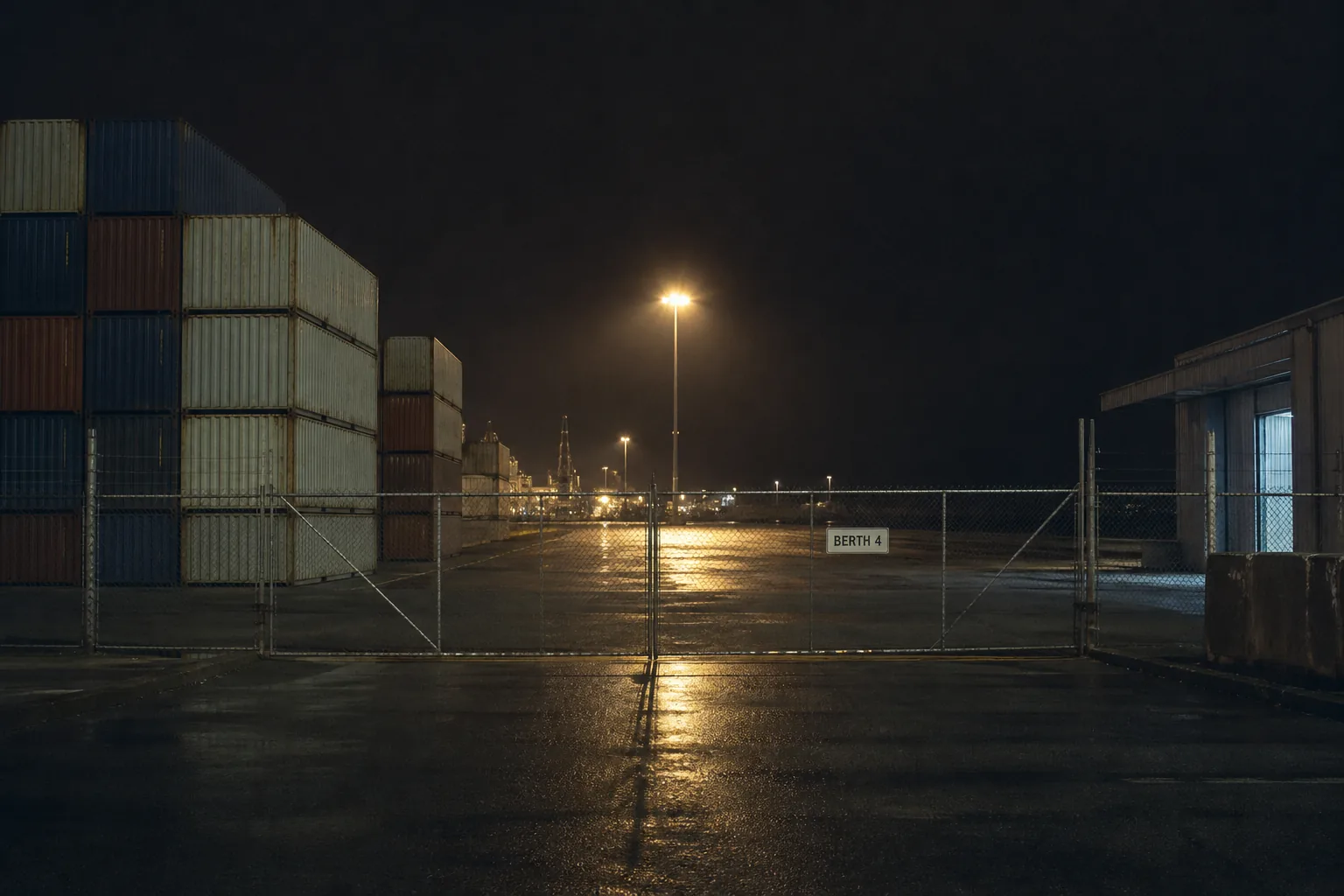
You’re standing in the port office because your container is already outside it — full, sealed, and committed to a vessel call that has stopped appearing under the day it was meant to leave.
The glass shakes a little when a truck goes past. On the far wall the departure screen keeps its blue glow and makes the absence look entirely deliberate.
The vessel name is gone. Your booking number is still on the sheet in your hand, with the stubbornness of handwriting.
The radio says the call is blanked. It says it once, then again for somebody who didn’t catch it. No apology gets anywhere near the sentence.
A blank sailing is a cancelled port call. Cancel the whole string and it’s a cancelled voyage.
The word is much smaller than the cargo sitting behind that fence, which is exactly what makes it useful. It gives the disappearance a shape before anybody starts calling it a breach.
“Capacity,” the dispatcher says into the radio. “Next available sailing.”
“That’s it?”
“That’s it.”
You know what that sounds like from where you’re standing. The ship was due. The ship isn’t coming. A promise has failed.
This office has no room for a feeling that size. It has a carrier screen, a terminal screen, and a line on your booking that has already moved to another departure.
An operations clerk brings up the service string, and there’s more than one carrier’s name beside it. That is not a casual arrangement somebody made in the hour before your call disappeared.
A vessel-sharing agreement is filed with the Federal Maritime Commission, and the agreement names the space each carrier purchases or exchanges and the particular string that space exists on. The Shipping Act puts the filing work under 46 U.S.C. 40301, and the limited antitrust exemption comes through 46 U.S.C. 40307. Competing carriers do not share capacity first and find out what it means afterward.
She touches the screen where the next vessel appears.
“Same service. Different week.” That’s the part you can see. Behind it, space has been taken out of one movement and pressed into another.
Carriers blank sailings when demand is weak, when cargo can be concentrated onto fewer departures, when congestion has made the old plan useless, or when weather or a mechanical failure or a regulatory deadline reaches in and takes the decision. Your cargo has no preferred reason. Your container has no vocabulary at all. The service string changes around both of them.
The radio calls another number and a gate clerk repeats it back. The office keeps working as though a vessel call is an item that can be lifted cleanly out of a day. It can. That’s what a blank sailing is — capacity management, and not normally an exception that needs your permission.
You put the booking sheet down beside the bill of lading terms, and this is where the words start coming apart from their ordinary use.
Your schedule told you what the carrier intended to operate. The bill of lading and the carrier tariff tell you what it promised. A published sailing date is promotional and operational information. It was never, on its own, the contractual commitment you thought you’d bought.
“The schedule isn’t the contract,” the clerk says. She doesn’t look up. She’s said it before, to people standing exactly where you are.
Your container can be late because the schedule is not the bill of lading. Your port call can vanish because the schedule is not the tariff. You read it again, slower, and the loss changes category on you. It’s still a delay. It is not automatically a breach.
On the radio shelf somebody has left a printout of a global liner performance report, and it isn’t a promise either.
It’s a measurement of how often promise-shaped things survive contact with water, ports, engines and everybody else’s cargo. Thirty-odd trade lanes, sixty-plus carriers. Global schedule reliability around sixty-five percent. Average late arrival running near five days behind. Reliability up nearly thirteen points on the year. None of those numbers tells that screen to restore your vessel. The sheet carries individual names underneath the average. The strongest majors sit in the seventies. The weakest is near fifty-three.
They look like instructions when you’re the one waiting. Nobody is required to achieve any of them, because no regulator sets a minimum liner on-time performance. The report measures. The market notices. The vessel still goes when the carrier operates it.
Where a service contract carries a schedule commitment, it’s one the carrier and shipper negotiated between themselves. It is not hiding inside a sixty-five percent. The report has already done its work for you. It gives you a way to name a pattern without mistaking the pattern for a rule.
The clerk has another paper now, and the question beside it isn’t whether your vessel will sail. It’s whether your container stays where it is long enough for the next call to matter.
“Free time,” she says.
“Meaning demurrage.”
“Meaning check it.”
Free time is not demurrage. It’s the period before demurrage begins after discharge, or before detention begins after pickup, and the allowance belongs to the carrier tariff, the terminal schedule, or the service contract.
At a terminal it commonly runs two to seven days before demurrage starts. Your actual window belongs to this carrier and this port, not to a sentence you remember from somewhere else.
She makes you find it yourself. You read the tariff, then the service contract, then the notation beside your container number. The work feels needlessly exact right up until you see what happens when the word slides. Free time is the clock before the charge. Demurrage is not the clock. Demurrage is what’s waiting after it. And that sentence is true in more than one place while meaning something different in each, which is the part nobody warns you about.
In a charter party, laytime is the allowance and demurrage is the per-day payment once laytime has run out. Despatch is the payment for finishing inside laytime — but only where the charter party provides for it, and most tanker forms don’t.
In liner shipping, tariff demurrage is the daily charge for leaving a container in the terminal past free time. In rail freight, the same word belongs to a railcar held past its own free time.
Three clocks. Three documents. Three different parties setting rates.
“Don’t call it laytime,” the clerk says.
You don’t. Your container is not a chartered vessel waiting under a laytime clause. It’s a liner container under a tariff or a service contract. The words are doing their part of the work now, and their part is stopping one charge from wandering into another charge’s paperwork wearing its clothes.
The next morning the radio says your container has a new sailing, and the office says nothing whatever about certainty.
The new call is a plan, and you know how plans behave now. The carrier has space somewhere on a string, and that space has to exist under an agreement filed for it — not under the idea that alliances are permanent furniture.
The names change on their own cycles. Gemini Cooperation carries Maersk and Hapag-Lloyd. Ocean Alliance holds CMA CGM, COSCO, Evergreen and OOCL. Premier Alliance holds ONE, HMM and Yang Ming, announced for five years of cooperation from early 2025, after Hapag-Lloyd left to form Gemini.
That list is not history hanging on a wall. It’s a capacity arrangement with a stated duration, a scope, and paperwork holding it up.
The radio calls the next gate move. Your container is still there. You haven’t made a sailing happen. You’ve learned where to look when one doesn’t.
An invoice turns up later for a different box, and it comes from a vessel-operating common carrier rather than from anybody on this radio. It has the soft threat of an ordinary email attachment. The heading says demurrage and detention. Somebody says it has to be paid because it’s on an invoice.
It doesn’t, necessarily, and not for the reason you’d guess. The billing rules are their own document with their own clocks, and an invoice has to arrive correctly before it can demand anything.
You put it beside yesterday’s booking sheet. One tells you a vessel did not come. The other tells you a charge has to meet a rule before it can ask for money. Neither one turns into the other because they both happen to contain a date.
A schedule is information and a bill of lading is a promise. Every argument anybody has in this office is really about which of the two they were reading when they made their plans.
Outside, a truck takes a container through the gate. The radio says its number, then the next one, without ceremony. The board has a vessel call on it again. You look at it and you don’t call it a promise.
You call it a schedule, and now you know what to do with the difference.
Check the record
Sources
- 46 CFR Part 535, Subpart D — Filing of AgreementsAccessed 2026-08-18
- Federal Maritime Commission, 60th Annual ReportAccessed 2026-08-18
- Maersk Shipping Instructions TermsAccessed 2026-08-18
- Sea-Intelligence: Global schedule reliability stable at 65%-68% since May 2025Accessed 2026-08-18
- FMC: Rules, Rates, and Practices Relating to Detention, Demurrage, and Free TimeAccessed 2026-08-18
- BIMCO Laytime Definitions for Charter Parties 2013Accessed 2026-08-18
- 46 CFR Part 541 — Demurrage and DetentionAccessed 2026-08-18
- Demurrage and Detention Billing RequirementsAccessed 2026-08-18
- FMC: U.S. Court of Appeals Issues Decision in Case on Demurrage and Detention Billing PracticesAccessed 2026-08-18
- FMC: Premier Alliance Agreement Taking EffectAccessed 2026-08-18