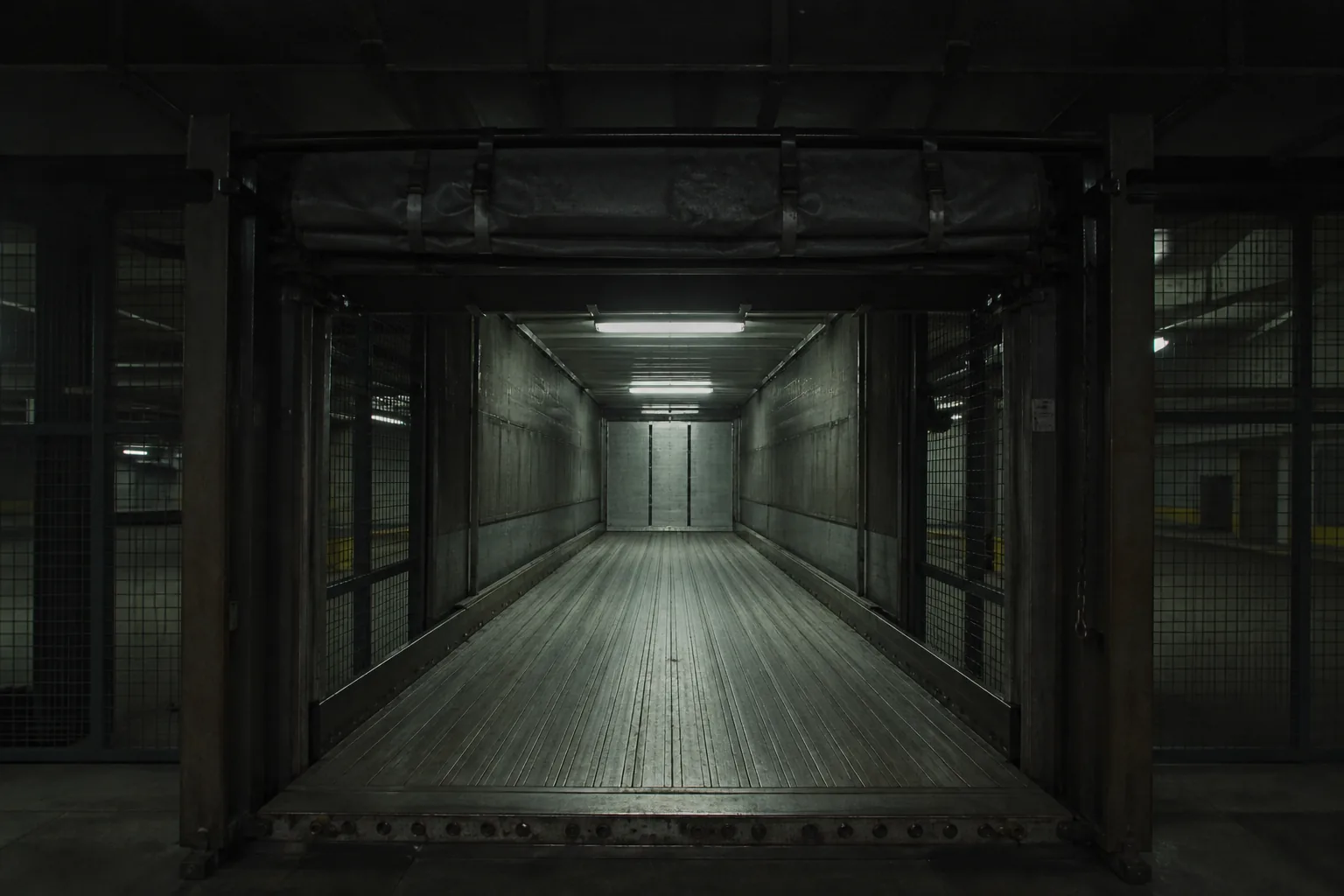
The trailer is empty when you find it, which makes it look simple.
The Conestoga cover is rolled forward on its top-rail tracks, bowed ribs gathered above the gooseneck. There’s deck from nose to tail, open on both sides, waiting for a forklift or a crane to decide it has a purpose.
Your manifest is on a clipboard at the dock door and the stops are already in order. That part got decided somewhere else, by somebody you won’t meet.
Somebody has written the first delivery at the top. That freight will be nearest the doors when the truck leaves. You know this only because Whitlock says it twice.
“First stop, last loaded. Last stop, first loaded.”
The empty trailer doesn’t contradict him. Its open side makes the instruction look optional, and that’s the first useful thing an open side does to you.
Nothing gets loaded yet, because nothing is allowed to be merely a pallet yet.
Every shipment on your manifest becomes a profile — weight, outer dimensions, stackability, fragility, and the securement it’s going to want once the road starts pushing at it. Density goes beside all that, weight divided by volume, because some freight fills a trailer long before it weighs one down and some does exactly the opposite. A cube-out and a weight-out look identical on a forklift. They stop looking identical at a scale.
One line on the manifest says metal coils. Whitlock puts a finger on it and waits until you find the note underneath.
Metal coils aren’t ordinary cargo for this purpose. Neither are logs, dressed lumber, paper rolls, concrete pipe, intermodal containers, automobiles and light trucks, heavy machinery, crushed vehicles, or large boulders. 49 CFR Part 393 Subpart I gives the named commodities rules of their own.
“So I count tiedowns and add a couple.”
“You don’t start by counting general tiedowns and hoping a coil forgives you.”
“Profile first,” he says. “Then you get to decide how it sits.”
The tare weights are on the other sheet, tractor and trailer recorded unladen by axle group.
Before a fork enters that deck, your freight’s weight gets set against the place it’s meant to occupy — forward of the trailer tandem, over it, or aft of it. The calculation uses the kingpin-to-axle and axle-to-tail measurements belonging to this trailer, not to the one in the next bay that looks much like it.
Federal Interstate ceilings are waiting inside that calculation. Twenty thousand pounds on a single axle. Thirty-four thousand on a tandem group. Eighty thousand gross. Those aren’t instructions for loading a trailer. They’re the edges of a shape your load has to fit inside.
State limits can differ on the road your driver actually takes, and the bridge formula can make axle spacing the binding limit before either flat number gets near you.
He writes it where the whole dock can see it.
W = 500(LN/(N−1) + 12N + 36)
It is not a calculation you perform with the trailer half full and a driver waiting at a scale. W is allowable weight in pounds. L is the distance in feet between the outermost axles of the group. N is the number of axles in it.
Two tandems thirty-six feet or more apart can carry the combined sixty-eight thousand pounds their two limits suggest. Bring them closer together and the bridge formula quietly lowers the combined allowance without asking whether your freight changed.
You look down the deck as though the answer might be printed in the aluminium.
The answer is a position. Load forward of the trailer tandem and weight shifts toward the drive axles. Load aft and it shifts toward the trailer tandem. Same freight either way. A deck is not neutral. It’s a lever with doors on one end.
Your first drawing puts a dense shipment in the nose, because it belongs to the last stop. The axle line comes back wrong — not by an amount anybody could see standing here, but wrong in the column beside the trailer tandem.
Whitlock doesn’t ask the crew to pull anything forward. He moves the tandem position on the diagram instead, fore and aft, and watches the weights redistribute.
“Distribution fix,” he says. “Not a weight fix.”
Sliding the trailer tandems changes which axle group inherits the weight. Moving the fifth wheel does the same work at the tractor end. Neither motion removes a single pound from the combination.
If you’re over eighty thousand gross, you don’t have an axle-position problem. You have too much weight, and no amount of sliding is going to be kind about it.
The second drawing works. It keeps the tandem under its limit, leaves the drive axles where the plan wanted them, and still makes room for your stop order.
Now the Conestoga cover earns its keep.
The side is open the full length of the trailer. A forklift can set last-stop freight into the nose without threading it through a rear doorway, and a crane can reach whatever the fork pockets can’t. The weatherproofing waits rolled forward above the work.
That cover is not a wall. A Conestoga is a flatbed or step deck with an accessory cover system — not a new structural species that has escaped flatbed arithmetic.
The crew starts at the last delivery. Its freight goes in first, deepest in the nose. Then the next-to-last. Then the one before that.
By the time your first stop’s freight arrives, the trailer has become a route turned backward. The delivery order is visible only if you can read depth. The open side changed how the crew can build it. It changed nothing about what they’re building.
On a rear-loading trailer the door end makes the sequence absolute — to reach the first stop without moving other freight, it has to go in last. A side-door or multi-door arrangement loosens that. A Conestoga loosens it further by clearing the whole side. Every accessible position still belongs to a stop, an axle calculation and a securement decision. Easy access was never an empty plan.
The coil arrives after your first-stop freight has been chalked out on the deck. It’s heavy in the ordinary way. Its note is not ordinary.
You don’t solve it with the general rule — an unblocked article over five feet and up to ten needs at least two tiedowns, with another for every additional ten feet or fraction, and aggregate working load limit reaching at least half the article’s weight. That rule exists. The coil has a rule written for coils. The profile told you that before anybody touched a chain.
For everything else, the general rules meet your deck where they have to. A tiedown system’s working load limit can’t be exceeded under 0.435 g forward, 0.5 g rearward and 0.25 g lateral. Cargo not fully contained by the vehicle structure needs downward force of at least twenty percent of its weight.
Blocking changes the count. An article blocked against forward movement can need one tiedown per ten feet instead. Your load order made some of that blocking possible, which is exactly why the drawing came before the straps.
Whitlock walks the length of the trailer with the diagram folded into quarters. First-stop freight by the doors. The cargo ahead of it. The coil and its commodity-specific securement. Nobody asked the crew to invent a load. They were asked to make the paper true.
Across the yard a double drop waits with its centre well low between the gooseneck and the rear wheels, deck sitting maybe eighteen to twenty-four inches off the ground where a step deck runs nearer thirty-seven to forty-two.
Beside it an RGN has its front neck detached, so a self-propelled machine can drive onto the deck from the front instead of being craned over the side. More setup. Shorter continuous deck.
Those are different ways of getting a thing onto a trailer. They were never different answers to what your axles will carry once it’s up there.
The cover comes back along its rails and closes over the load with the slow mechanical patience of a door that knows weather isn’t its only job.
Your side access is gone. The first stop is still nearest the rear. The axle summary is still a prediction made out of tare weight and position, and the loading diagram is still the thing your driver didn’t make and now has to trust.
At the gate he walks the securement before he takes the keys. Chains or straps. Blocking in place. Tiedown count. A pre-trip check isn’t a ceremony performed for the diagram. It’s the last chance anybody has to find out the diagram wasn’t executed. He inherits your route after the dock crew turned it backward, and inherits your weight distribution after everyone who calculated it has gone home.
The truck pulls out with the first delivery closest to leaving, and none of that is intuitive until you’ve watched the last delivery vanish into the nose first. The doors close. The cover holds. Somewhere out on the road the route starts undoing your trailer in the only order it can.
Check the record
Sources
- 49 CFR Part 393 Subpart I: Protection Against Shifting and Falling CargoAccessed 2026-08-18
- FHWA: Bridge Formula WeightsAccessed 2026-08-18
- 49 CFR 392.9: Inspection of Cargo, Cargo Securement Devices and SystemsAccessed 2026-08-18
- NMFTA: How Is the Density of a Handling Unit Calculated?Accessed 2026-08-18
- Aero Conestoga Rolling Tarp SystemAccessed 2026-08-18
- Talbert 30-55 Extendable Double Drop TrailersAccessed 2026-08-18
- Trail King TKHDG Hydraulic Detachable GooseneckAccessed 2026-08-18
- FHWA Truck Size and Weight Study Working Paper 5Accessed 2026-08-18