The yard smells of diesel and wet lumber. Forklifts move through sodium light in short deliberate arcs, tines down, drivers not looking at each other because they already know where everyone is. You stand at the dock edge holding a flashlight somebody handed you without explaining why.
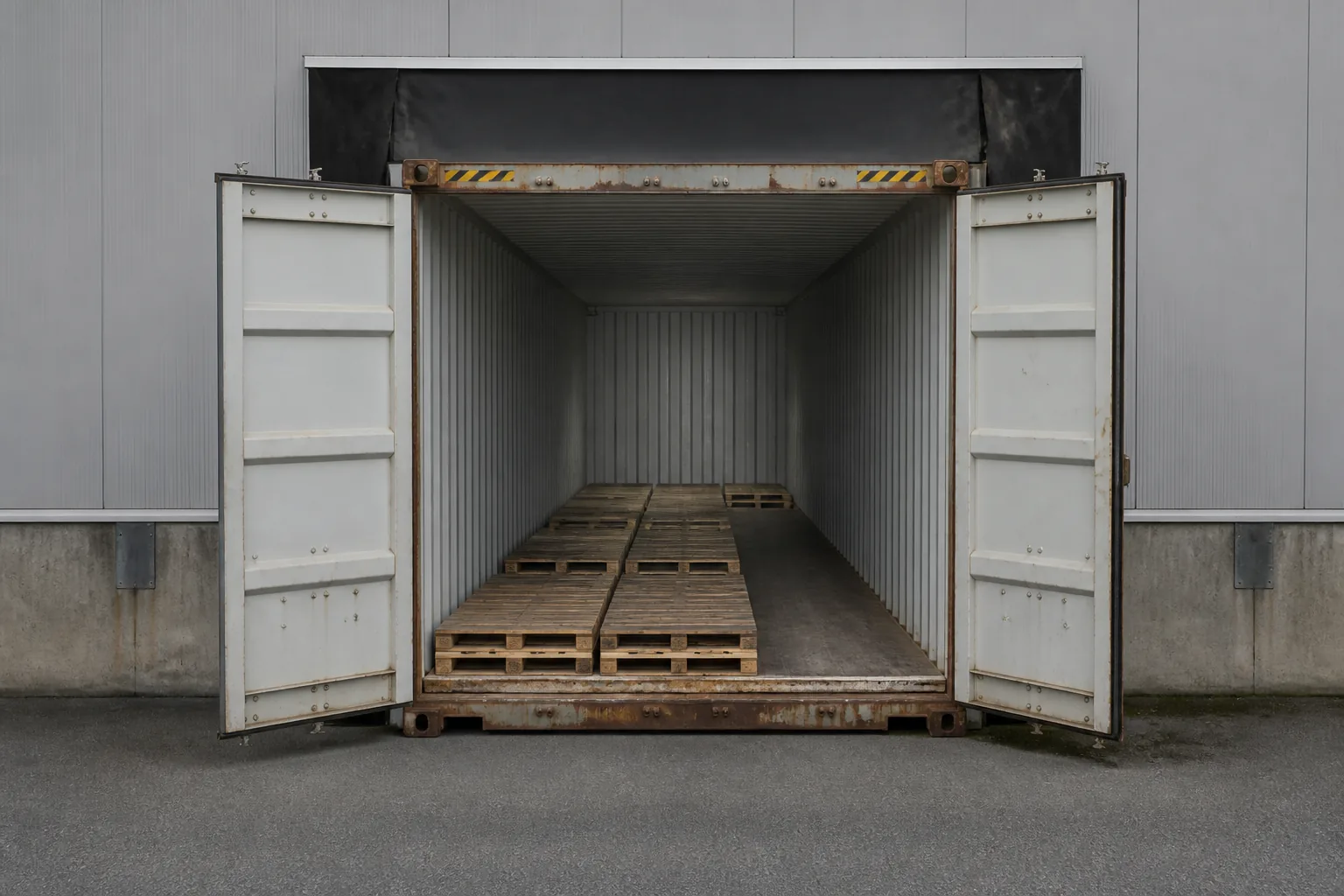
Behind you a forty-foot box sits backed against the bumpers, doors swung wide, the interior going dark about four metres in. A steel plate is riveted beside the right-hand door: the country that approved it, the year, a number. Someone inspected this box once and every port between here and Antwerp has agreed in advance to believe them. That agreement is the only reason it is allowed to leave.
A checker comes down the line with a paint stick behind her ear.
“Loads are built,” she says. “You’re on wood.”
She doesn’t ask what you know. You have moved pallets. You have counted them, wrapped them, taken them off a truck in the rain. You have never once looked at the underside of one.
“Six millimetres,” she says. “Anything thicker than six millimetres of wood going into that box needs a mark. Pallets, crates, the dunnage you jam in the gaps. Marked or it doesn’t go.”
“What about—”
“Six millimetres. Marked or it doesn’t go.”
She turns a pallet up on its edge with her boot, unhurried, and puts your light where she wants it. Burned into the stringer is a small rectangle: a stalk of wheat, then a two-letter country code, then a number, then two letters — HT.
“Wheat sheaf means the treaty. The code is the country. The number is whoever did the treating, and they’re on a list somebody keeps. HT means heat. Fifty-six degrees for thirty minutes.” She taps the wood. “At the core. Not the surface. The oven doesn’t get credit for warming the outside.”
“And if it says MB?”
“Old stock. Gas — methyl bromide. Some places still allow it. Europe hasn’t since 2010, so read the destination before you read the stamp.” She lets the pallet drop flat. “You’ll also see DB for debarked and DUN for dunnage. Bark is where the things we’re worried about live. It comes off before treatment, and a patch here and there is tolerated, and a strip running the length of a stringer is not.”
Ninety-some countries signed onto this. The Europeans and the Americans both from 2005. Somebody sat in a room and decided that a beetle inside a plank counts as freight, and now a stamp the size of a business card is the difference between a load sailing and a load being fumigated, sent back, or burned at somebody else’s dock at your expense.
“Last thing,” she says. “You don’t argue with a mark you don’t like. You pull the pallet. Pull it and re-stack the load.”
“What if I’m wrong?”
“Then you were wrong here, where it’s cheap.”
You start at the north end of the lane and work in.
The first one takes you two minutes. You crouch, you find nothing on the stringer face, you walk around, you find the mark on the opposite side at the far end, upside down. The second takes ninety seconds. By the sixth you are checking the stringer face and the diagonal corner in one motion, and by the twentieth your light is already on the right block before you have finished squatting.
They are almost all the same footprint here: forty-eight by forty inches, the North American grocery standard, seven boards across the top and five underneath, three stringers running the long way with notches cut into them at the third points so a pallet jack can come in from the side. Sixty, seventy nails a pallet. Nobody thinks about the nails until one of them is standing proud of the deck by three millimetres, waiting for a hand.
You find one like that on the fourth row. The nail has walked itself up out of the wood — the lumber dried and shrank, the steel didn’t, and the joint gave the difference back at the surface. The stamp on that pallet is clean. It is still a nail pointing at the ceiling of a box nobody will open for five weeks.
You set it aside. The checker walks past, looks at it, doesn’t ask.
The eleventh row has a blue one in it.
You know the blue. Everybody knows the blue. It is a pooled pallet, block-built, painted so that it can be identified from across a yard, and it is stamped, treated, entirely legitimate. It is also not yours. It belongs to the operator that issued it, who will want it back, and who has an actual process for sending its own equipment across an ocean that nobody standing on this dock has followed. Loading it is not a customs problem. It is a slower and more embarrassing kind of problem, the kind that arrives in an invoice eight weeks from now addressed to someone who will have to ask who did this.
You pull the blue one. Somebody’s whitewood goes in its place, checked twice because you are starting to enjoy being right.
Row fourteen is the one that teaches you something.
The stamp is there — wheat sheaf, code, number, HT — burned into a stringer that has been in service long enough to go gray. But the third deck board from the entry face is new. Bright, square-edged, still smelling faintly of mill. Someone replaced a broken board and put the pallet back into rotation, which is the correct and thrifty thing to do, and the pallet in front of you is now a treated pallet with a piece of untreated lumber nailed into the middle of it.
You look at it for longer than you should.
“Problem,” the checker says. Not a question.
You show her. She looks at the board, at the stamp, at the board again.
“Pull it,” she says.
“The stamp’s good.”
“The stamp’s good for the wood that was under it when they burned it in.” She is already moving. “You’re not going to win that conversation with somebody at a border who doesn’t speak your language and gets paid the same whether he lets it through or not.”
They load in the afternoon.
The forklift driver comes at the box square, dead centre, no angle, and slows in the last metre — not from caution, but because the fastest way through a container door is to not touch anything. The first pallet seats against the front wall. The second lands beside it. The third goes in behind the first and the pattern is set and after that it is arithmetic performed by a man who has never written it down.
You watch two rows go in and you see the gap.
The pallets are forty inches across. Two of them side by side use eighty inches of a box that has somewhat more than that, and what is left is a strip of empty air running the whole length of the container, floor to load height, all the way to the doors. Not enough to take a third pallet. Not enough to take anything. It is the box paying for the fact that the box and the pallet were standardized by two different sets of people in two different decades for two different reasons, and neither of them was thinking about the other.
The dunnage goes into the gap. Sawn timber, stacked, keeping the rows from walking sideways for five weeks of swell.
You check every piece of it. Six millimetres.
There is a fourth row and a sixth and a ninth, and somewhere around the ninth you stop counting rows and start counting the rhythm — the driver’s reverse alarm, the settle, the pause, the alarm again. Load, seat, block, check. The wood goes in. The box takes it.
The last row goes in short by design, leaving room for the doors to swing.
The checker walks the length of the container with her light, says nothing, comes back out. She closes the right door, then the left, and drops the locking bars into their keepers with a sound the whole dock hears. Then she runs a numbered seal through the hasp and pulls it until it clicks.
She writes the number down twice. Once on her sheet, once on a form that goes somewhere else.
“That’s it,” she says.
“What happens to it?”
“It goes.” She caps the pen. “It’s not ours now. Anything wrong with it is wrong somewhere I’ve never been.”
You look at the box. It is a rectangle of painted steel with a number on the side, and inside it, riding under forty thousand pounds of somebody’s freight, are two hundred and some pieces of nailed pine that each had to be cooked to fifty-six degrees for half an hour and then branded, because a treaty says so, because of insects.
Somebody wrote fifty-six. Somebody else wrote thirty minutes. Between them they decided which beetles get to cross an ocean, and that counts as civilization.
The tractor comes for it at 16:40. You feel it leave through the deck plates more than you hear it.
The next box is already backing in. The doors come open on four metres of dark, and the pallets for it are stacked in the north end of the lane where you started, and you walk up there with the light because that is what happens next.
You find the first stamp without crouching.