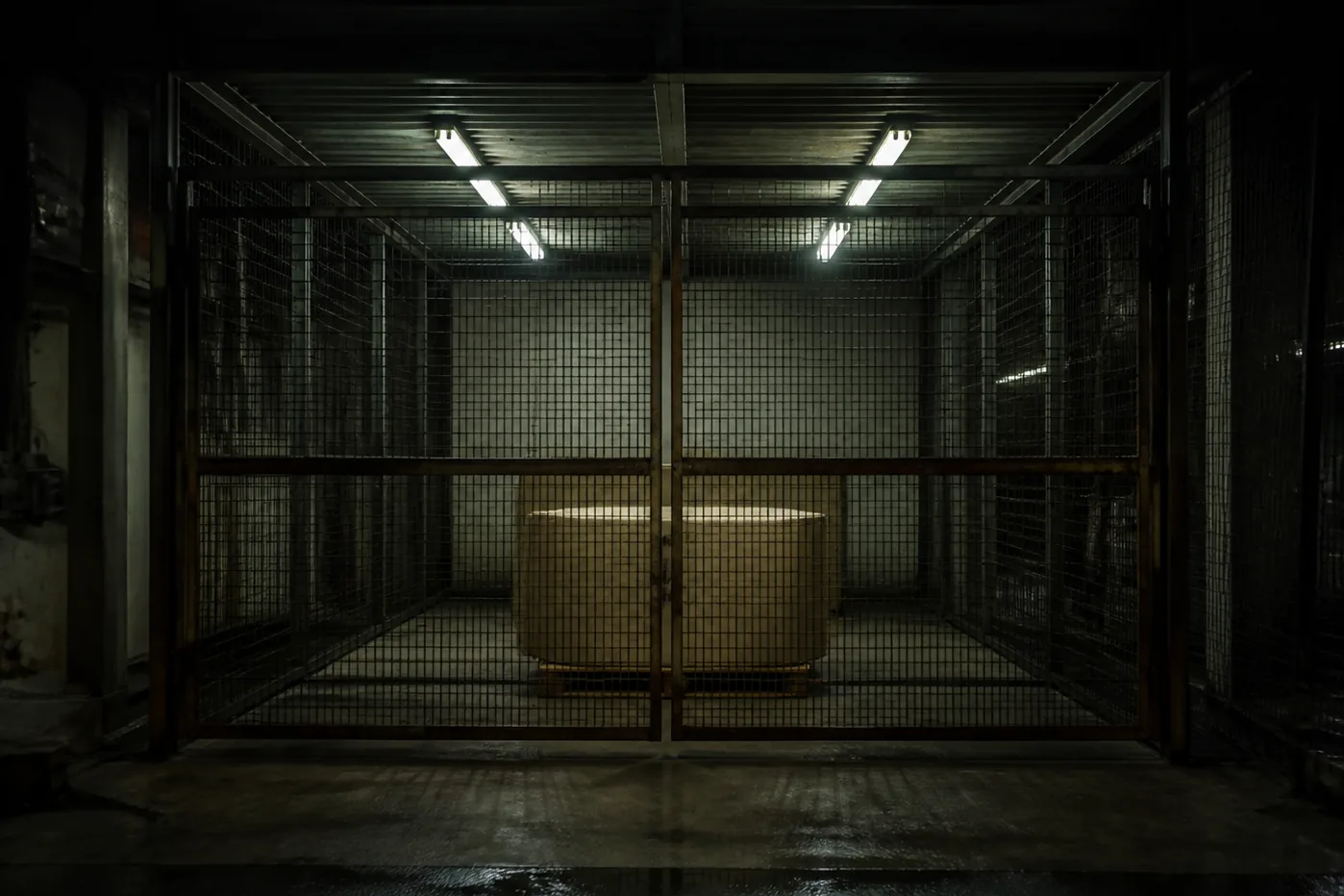
The ULD waits under a white roof that turns every afternoon into the same permanent weather report.
Its net is pulled tight over ordinary cartons, except for your square shipment in the middle, which somebody has given a little clearance around. There’s a battery mark on the outer face and your declaration in the pouch.
It arrived before cutoff. Your forwarder has done all the parts of the work that look like a journey.
The pouch is neat and your papers have been squared at the corners. That’s how a shipment looks when every earlier desk has said yes to it.
The security record is in order too. Your cargo originated with a known consignor and came through a regulated-agent chain, so it doesn’t have to sit here waiting for the kind of re-screening that turns a terminal aisle into a queue. That status runs five years before revalidation under the EU system. It moved the screening upstream. It never turned a handler’s dock into a place where other questions go away.
Abiodun walks your ULD with a scale ticket in one hand and the manifest in the other. Weight. Contour. Documents. He runs it in that order every time and there’s no room anywhere in the sequence for a package that is nearly right.
The contour passes. The weight agrees.
Your battery carton is the one that slows the papers down.
He takes your declaration out of the pouch and reads it twice.
Your shipment is entered as electronic accessories. Your outer carton carries a battery mark. The description and the mark are looking at each other across one small piece of paper and not agreeing about anything.
A mark identifies a substance. A diamond label tells a handler its hazard class. Neither one is decoration, and one correct mark has never made a document correct.
“What is it?”
You know what it is in the ordinary way. It powers equipment. The supplier called it a module. The purchase order carried a product name that fitted a narrow column. None of that is an answer at this desk.
There are nine hazard classes in the UN system, and lithium batteries sit in Class 9 among the miscellaneous dangerous goods. The governing entry is where you find the UN number, the proper shipping name, the class, the packing group where one applies, and the required label. Your product name gets no vote. The list decided which words count long before you got here.
“So it’s undeclared.”
“No.” He sets the paper down. “Undeclared means there’s no declaration. You’ve got one. Yours says something false.” That distinction stays dull right up until somebody has to find the failure, and then it becomes the whole file.
He calls the forwarder. The forwarder calls somebody further back down the chain.
What comes back to you is a safety data sheet, then an older copy of the same sheet, then a silence long enough for you to hear a forklift reversing in another bay.
Infrequent shippers fail here, and they fail for one reason: nobody upstream recognised that the classification question belonged to them.
One national authority logged an average of a dozen reports a year across a five-year span for undeclared dangerous-goods cargo, most of them caught during acceptance or security screening before anything was loaded. That count is what got caught. It makes no promise whatever about what didn’t.
“Who signed this?”
The declaration can’t be repaired by whoever happens to be nearest the printer, and you find that out by offering.
Under the IATA Dangerous Goods Regulations, the Shipper’s Declaration for Dangerous Goods is completed and signed by a person holding current dangerous-goods training. The regulations get republished annually. The training belongs to the person making the declaration, because that’s the point where a company stops being a company and becomes a specific set of words beside a specific package. Your form is withdrawn. Your carton comes out from under the net.
Your ULD is still perfectly sound, and it makes no difference at all. A built ULD can fail its documentation check with a clean contour, the same way a shipment can fail its packaging check with a correct classification.
None of this work averages out.
Your classification gets corrected and your declaration prepared again, and now the quantity has to be read against air’s own limits.
Air carries tighter quantity thresholds and a longer list of forbidden goods than the ground does. There’s no helpful number you can guess from the outside of a carton — quantity is a threshold sitting in the governing entry, not a feeling about how small a battery looks in somebody’s hand.
Then Abiodun turns your carton so the bottom seam faces the light.
Your outer package carries a UN packaging code, and it tells him the container type, the manufacturer, and the packing-group level it was tested to meet. A UN-specification package earned that mark through drop and stacking tests, and a hydrostatic-pressure test where it carries liquids.
The mark says a design survived those tests. It has never said every carton wearing the same mark was assembled as that design.
Inside, your records name an inner packaging that got changed at filling. Nobody left a verification that the substitute was compatible with the tested outer package, and your closure record is no comfort either. This isn’t a new classification problem. Your Class 9 entry is still your Class 9 entry. This is a package assembled to look like a tested design without the process that earned the mark.
There’s a shallow deformation on one corner, not dramatic enough for you to read as damage from across the bay. Up close it has turned the paperboard into a question.
A package gets stopped for exactly that. Air cargo intercepts packages whose outer packaging shows deformation inconsistent with the conditions it was tested to survive, and a battery short circuit inside packaging that meets its marking requirements but wasn’t assembled to the tested design can reach thermal runaway in flight. He doesn’t need to make any of that worse in his head. He only needs to keep it out of the hold.
“Rebuild it.”
Your rebuilt package will need its documents checked over again, and then it needs somewhere to sit in the aircraft loading plan.
Segregation starts after acceptance, and it belongs to the carrier. You classify, package, mark, label and declare. The carrier decides what is allowed to share a vehicle, a stow position, or a hold with it.
On a road table an X means those two classes are forbidden together. An O means they have to be physically separated, so a leak or a rupture can’t commingle them. A blank means no restriction for that pair at all.
An aircraft hold has far less room to put between things, which is exactly why air’s forbidden-combination list runs longer than sea or road. The chemistry didn’t become stricter in the air. The available distance became smaller.
The load planner reads your corrected declaration, then reads the cargo already assigned to the flight, because the actual load is the only thing that matters to you now.
A segregation check run at booking does not survive a changed manifest through good intentions. Cargo gets added. Cargo gets substituted. A combination that was perfectly legal when somebody typed the booking can be impossible by the time the doors are closing.
There’s no position for your carton today.
The cutoff has done its work. Your ULD gets opened, your battery shipment held back, and the rest of the freight either rebuilt or rolled along with it under a new plan. The flight will leave carrying a space that looked sold to you from a distance.
You watch Abiodun set your package down in a marked holding area.
It made it to the airport. It was screened. It was measured. It was early. It was marked, and its declaration existed. Not one of those things meant it could enter an aircraft hold.
A signature on a declaration requires training. A drop test belongs to a design rather than to any particular carton. Between them, those two sentences have put your shipment on a concrete floor instead of in the sky.
The next flight hasn’t opened its cargo cutoff yet, and that’s the entire extent of what the system is willing to offer you.
Your carton waits under the same white roof with the corrected classification beside it and the packaging work still ahead of it. The airline hasn’t lost it. The airline hasn’t accepted it. Those are two different conditions, and you can see the space between them now.
Check the record
Sources
- IATA — Air Cargo Tariffs and Rules: What You Need to KnowAccessed 2026-08-18
- IATA — Dangerous Goods (HAZMAT)Accessed 2026-08-18
- IATA — How to Get Trained and Certified on Dangerous Goods Transported by AirAccessed 2026-08-18
- IATA — Shipper's DeclarationAccessed 2026-08-18
- IATA — Shipper's Declaration for Dangerous Goods (open format)Accessed 2026-08-18
- IATA Resolution 600b — Air Waybill Conditions of ContractAccessed 2026-08-18
- 49 CFR Part 178 Subpart M — Testing of Non-bulk Packagings and PackagesAccessed 2026-08-18
- 49 CFR Part 172 Subpart D — MarkingAccessed 2026-08-18
- 49 CFR Part 172 Subpart E — LabelingAccessed 2026-08-18
- 49 CFR 177.848 — Segregation of hazardous materialsAccessed 2026-08-18
- 49 CFR 173.185 — Lithium cells and batteriesAccessed 2026-08-18
- 49 CFR 172.200 — ApplicabilityAccessed 2026-08-18
- Civil Aviation Authority of Singapore — The Leading Edge: Preventing the Transport of Undeclared Dangerous GoodsAccessed 2026-08-18
- Commission Implementing Regulation (EU) 2015/1998Accessed 2026-08-18
- 49 CFR Part 1549 — Certified Cargo Screening ProgramAccessed 2026-08-18