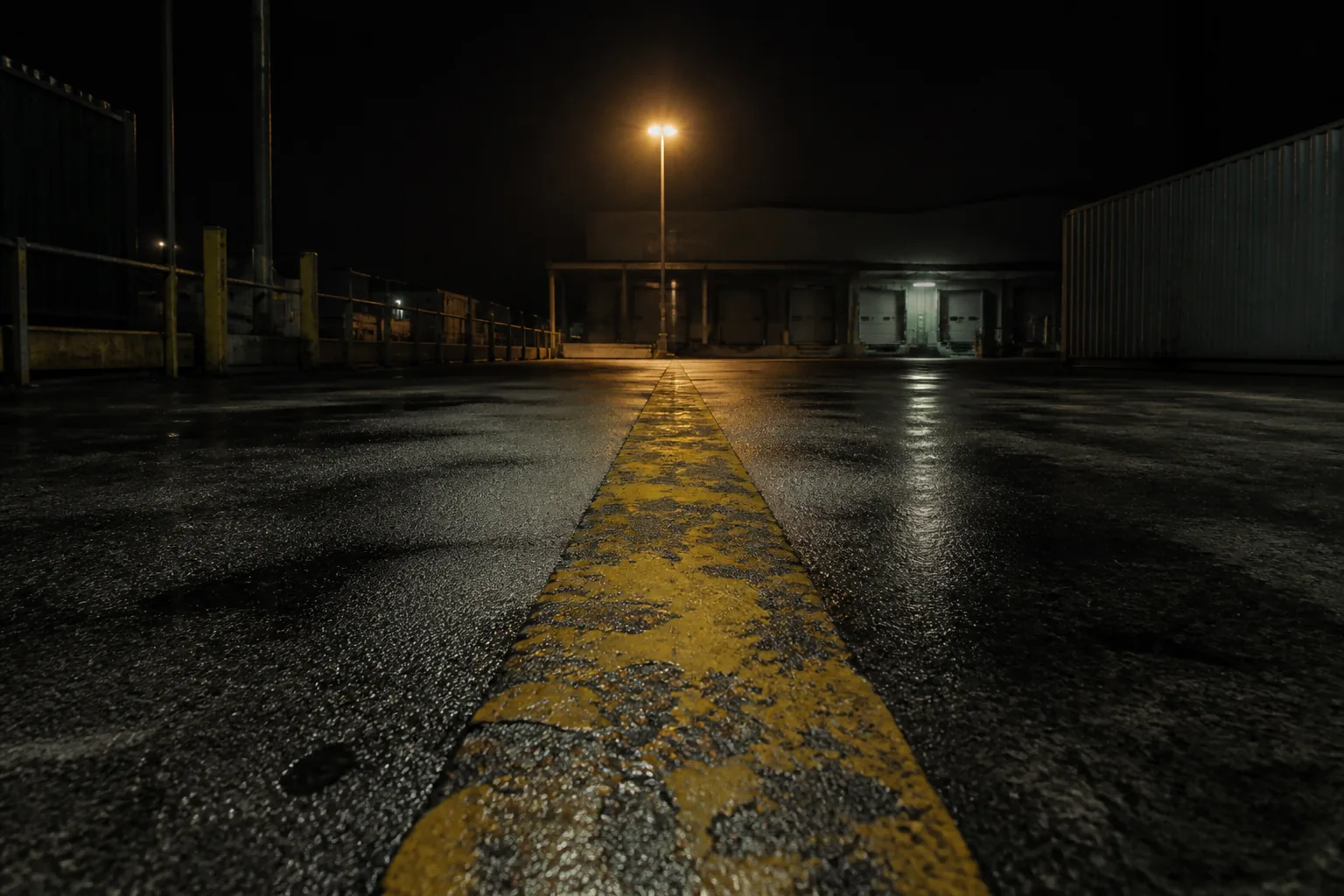
Receiving doors stand open and the building smells of wet cardboard, diesel, and the sweet dust that comes off stretch wrap when a pallet has been moved too many times.
A sign over the office says CONTRACT LOGISTICS in letters you could read from the road. Inside, the floor is marked with locations, rack uprights, staging lanes, and a red line that stops short of a pair of grey doors.
Beyond the line the lights are the same. The concrete is the same. A forklift has worn the same shallow arcs into both surfaces. You can’t see the difference until somebody tells you where to stand.
“That room,” Vasquez says, pointing at the grey doors, “is bonded. This building is not.” She says it the way you’d correct somebody about a colour. You have heard people call this place a bonded warehouse. The sign says contract logistics. Both descriptions are incomplete, in opposite directions.
The licensed footprint is the room and the defined area behind its doors. Everything else on this floor holds domestic goods — ordinary goods, things that can be put away or picked without anybody having this conversation over them.
A tractor backs to the dock with your trailer, which came inland under bond from the port of arrival.
The paper in the clerk’s hand says your merchandise is moving in-bond for transportation and rewarehousing. Duty wasn’t assessed at the transit point. It couldn’t be, because your shipment is still moving between ports under continuous bond and customs control. It has travelled a very long way without ever becoming domestic stock.
The clerk checks your trailer number, then your paper, then the red line. Those three checks are what make a line on a floor into something other than paint. Your load can cross it. Your load cannot become whatever the building sign seems to be promising you.
“Not over there,” she says, when the driver angles toward the domestic staging lanes. “Bonded room.”
He pulls the freight clear of the dock plate and waits. The port of arrival is behind your shipment now. The in-bond condition is not behind it.
Transportation and rewarehousing means the duty question followed your load inland instead of being settled at the coast. Continuous bond and customs control aren’t scenery on that document — they’re why the pallet has a destination more exact than a receiving lane.
The clerk makes him hold it while the room gets opened. Nobody’s accusing you of anything. The process is simply not finished because your trailer arrived.
A port can be the place where merchandise arrives. It can also be the place a later warehouse entry has to make sense of. The paper is what joins those together, and if it doesn’t agree with the pallet and the licensed footprint, no line on this floor is going to repair it.
The driver corrects without arguing. You watch the pallet jack turn — a small movement, and it decides where your goods are.
On the domestic side a pallet is waiting for an order or a slot. On the other side, merchandise has been entered for warehousing, and it stays at the expense and risk of its owner, purchaser, importer or consignee, with duty deferred for exactly as long as it remains under customs control. The room doesn’t make your duty disappear. It stops the decision arriving yet.
There are ten active customs-warehouse classes in 19 CFR Part 19, and Vasquez hands you none of them. She taps a certificate in a plastic sleeve beside the doors instead.
“Class 3 here. Read the room, not the roof.”
Class 3 is public bonded warehouse space. The contract operator can run this portion for your import consolidation while the same operator moves domestic freight on the other side of the line for somebody else entirely. The licence doesn’t spread because a building has one ceiling. That would be convenient, and it isn’t how any of this works.
She calls it public because the certificate calls it public, not because the room is open to anybody who walks in off the dock. Another file on her desk concerns a Class 2 private warehouse, where the using company carries the occupancy commitment itself.
Those labels describe different arrangements. They never collapse into a story about who owns the building, who drives the forklifts, or whose logo is over the gate.
The people unloading your trailer wear the operator’s logo on their vests, and that settles nothing for you either. A manufacturer can own or directly lease a facility, bear the occupancy risk, and still have a third-party operator staffing receiving, putaway and picking. Private and third-party-operated are true together all the time. The work boots don’t decide who carries the real-estate and volume risk.
Your pallet crosses the red line. Vasquez scans it and waits for the screen to answer.
The doors close behind your load without any drama at all. They close because a different storage and withdrawal process starts on the other side, and the operator has the room now. The scanner record, the warehouse entry and the physical pallet all have to go on agreeing with each other.
You expect the words bonded warehouse to tell you what can happen inside. They explain considerably less than you want.
The class has to do that work for you. A Class 8 room can clean, sort and repack imported merchandise under customs supervision — a manipulation-only facility. It cannot manufacture your goods. A Class 6 warehouse is for in-bond manufacturing. The same cartons can sit looking equally patient on a floor while the permitted operation above them is a completely different thing.
“Class 8 means clean it, sort it, repack it,” Vasquez says. “It doesn’t mean make it.”
She says it again while somebody walks a domestic pallet past you and the doors, close enough to touch, its labels facing into the bonded room.
The separation is still real. A room licensed for Class 8 work doesn’t become Class 6 space because there’s labour standing around and tape on the bench.
The next record that matters isn’t today’s receiving date, and it’s the one that catches people.
Your merchandise can’t stay in bonded storage beyond five years from importation, unless the Center director grants a discretionary extension on request and good cause shown.
That clock didn’t start at this door. It started when your goods were imported, and it keeps its own time whether anybody is watching it or not.
“Five years,” Vasquez says, without lowering her voice. “Not from receipt.”
The phrase travels through the room with your pallet. It belongs on the storage decision, on the release decision, and on the quiet review somebody makes before the date catches up with everybody.
Your goods may be withdrawn for domestic consumption, and duty gets assessed then. They may be exported. They may be destroyed under customs supervision. Until one of those three things happens, the duty stays deferred and the merchandise stays where customs can account for it.
At the far end of the room a desk carries a plaque that says FTZ, and you look from that to the bonded certificate and make the obvious mistake.
“Different thing,” Vasquez says.
A Foreign-Trade Zone is a geographic area designated by the Foreign-Trade Zones Board, where merchandise may be admitted and, in many zones, manufactured or assembled. Duty is generally assessed on finished output when it formally enters United States commerce, unless your merchandise carries privileged-foreign status.
Bonded warehousing is not the same duty mechanism wearing a shorter name. The two can share an address and sit within sight of each other and remain entirely different systems.
Somebody in the office is working a file where duty has already been paid, and their deadline sounds uncomfortably familiar. A qualifying export or destruction and a drawback claim generally have to happen within five years of importation, with a standard refund of ninety-nine percent of duties, taxes and fees paid.
The matching number is a trap and you should expect to fall into it once. This room’s five years controls storage before duty. That file’s five years controls a claim after payment.
The analyst stops at an eight-digit HTS subheading and checks it twice. Substitution drawback can use domestic or differently sourced merchandise classified under that same eight-digit subheading instead of the literal imported unit — except where an “other” subheading makes you match the ten-digit statistical reporting number too.
That’s one more way the records decide what a pallet is allowed to mean. It’s not a way to turn your bonded pallet into a drawback claim while it waits behind the grey doors.
By now you can read the building properly.
The sign still says contract logistics. The domestic lanes still run along the wall beside you. A private owner may carry the occupancy risk while a third-party operator runs the floor, and the FTZ desk can sit at the same address as all of it.
None of that reaches the room.
Somebody licensed a footprint rather than a building, and everything true about your pallet for the next five years follows from a line that somebody painted on a floor.
The forklift comes back out of the empty footprint carrying the next in-bond pallet and stops at the red line. The operator scans the paper, opens the doors, and takes the load into the process waiting behind them. There’s nothing here for you to approve. The room has accepted your goods, and the clock has been running since long before they arrived.
Check the record
Sources
- 19 CFR § 19.1 — Classes of customs warehousesAccessed 2026-08-18
- 19 CFR § 19.2 — Applications to bondAccessed 2026-08-18
- 19 CFR § 19.4 — CBP and proprietor responsibility and supervision over warehousesAccessed 2026-08-18
- 19 U.S.C. § 1557 — Entry for warehouseAccessed 2026-08-18
- 19 CFR § 144.5 — Period of warehousingAccessed 2026-08-18
- 19 CFR § 18.1 — In-bond application and entry; general rulesAccessed 2026-08-18
- International Trade Administration — About Foreign-Trade ZonesAccessed 2026-08-18
- Foreign-Trade Zones Board — FTZ RegulationsAccessed 2026-08-18
- 19 U.S.C. § 1313 — Drawback and refundsAccessed 2026-08-18