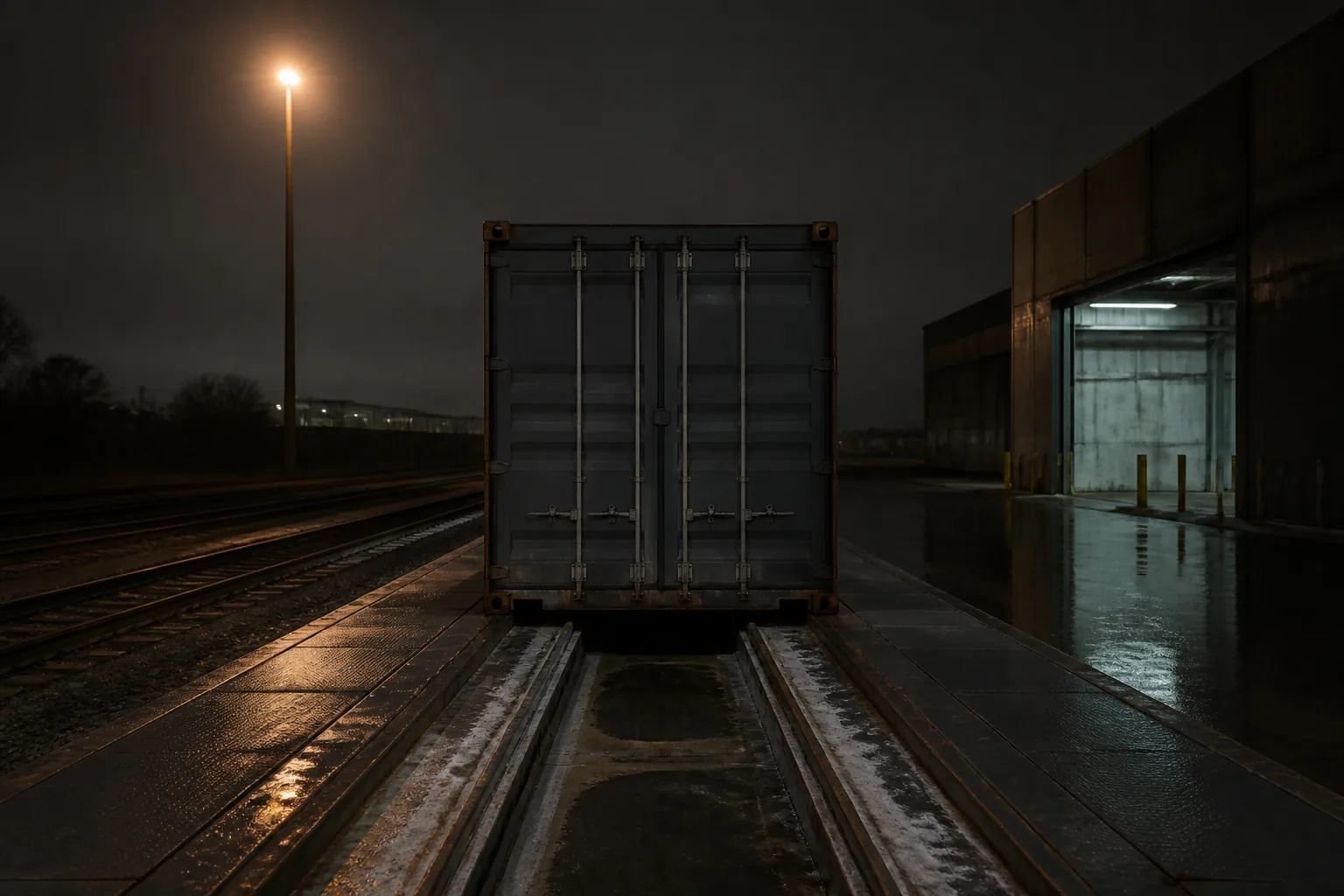
The box waits under a gantry crane that has no interest in it. Steel wheels complain somewhere behind the fence. There’s salt dried into the door channels and a seal drawn tight through the hasp.
The number on the side has been written down enough times to become clean. It came off a ship. It has a sea declaration.
It is still not on the train.
The clerk at the ramp window takes your envelope without looking up at you. She finds the IMDG Dangerous Goods Declaration first and reads the whole of it — shipper, consignee, UN number, proper shipping name, class, packing group, quantity, packaging type, emergency contact.
Then she puts it back in the envelope.
“That’s for the vessel. Where’s the rail paper?”
You look at the seal as though it might answer for you. It doesn’t. A seal proves the door hasn’t opened, and it has no opinion whatsoever about 49 CFR 172 Subpart C.
She turns her screen around. Blank fields in a fixed order.
The road-and-rail shipping paper has to accompany the shipment. The emergency response telephone number has to be reachable the entire time the material is in transportation. The same UN number goes into it. The same proper shipping name goes into it, word for word. Your sea declaration didn’t become false when the box crossed the ramp. It was simply never going to be enough on its own.
“Start at the beginning,” she says. “What is it?”
You know what’s in the box in the ordinary way. You know the product name off the purchase order, the supplier’s name, the colour of the drums through the open warehouse door.
None of that is an answer here.
Classification isn’t a lookup somebody performs because a gate is blocked. It’s a technical determination made before the package was chosen, before the mark was printed, before anybody typed a declaration.
For a known substance that determination already exists in a list — the Hazardous Materials Table at 49 CFR 172.101, the Dangerous Goods List in IMDG Code Chapter 3.2, or the list in the IATA regulations.
For a new mixture somebody did harder work than that. Flash point and boiling point for a flammable liquid. Corrosivity on skin or metal for Class 8. Testing under the UN Manual of Tests and Criteria for an oxidiser. Where more than one hazard applies, precedence rules decide which leads and which follows. Nothing downstream is allowed to improve on that decision, and you are downstream.
She taps the UN number on the sea declaration.
“This is the part that survives the ship. Not the form. This.”
The number points to a proper shipping name in the governing list, not to a trade name that happened to fit on a label. The packing group comes with it where the class uses the three — I, II, III.
You don’t pick a package and then decide which group makes it legal. The group comes first. It’s the thing your package has been waiting to be told about itself.
You call the person whose name is on the shipper line. There’s a pause, then paper moving, then the sound of somebody finding the safety data sheet they should already have had open. They read the proper shipping name to you. You read it back to them. The spelling is the work.
The UN number and the name have to match on the document, on the package, and in the record the next carrier keeps. A good seal has never once held a bad identity inside a box.
At the inspection lane the package marks are behind glass and steel, and you can’t put a hand on any of them. All you can do is compare what’s visible through the container’s inspection opening against what your shipper says is in there.
The ramp inspector makes you read it twice, and in a particular order.
There’s marking on the package face when the floodlight catches it. UN, then the number, then the proper shipping name. Marking is text.
Beside it is the diamond. Labelling is the hazard class — one of the nine class pictograms shared across 49 CFR, IMDG and IATA, because all three inherited the scheme from the Orange Book. Where a subsidiary hazard applies, a second label belongs next to the first.
“One tells you what it is,” she says. “The other tells you what kind of trouble it is.”
“And if they disagree?”
“Then somebody quiet made a mistake and you’re the last person who can catch it.” So you read both. The number agrees with the name. The name agrees with the shipping paper. The label agrees with the class.
It’s slow the first time, because a package looks entirely correct from a distance. A correct diamond over the wrong UN number fails. A correct UN number under the wrong diamond fails.
Those marks are there so somebody standing at a gate can catch an error made somewhere much quieter, months earlier, by a person who will never hear about it.
The rail paper comes through later. The basic description sits in its fixed order. The emergency number answers, and the clerk listens long enough to hear an actual person before she hangs up.
The terminal accepts your box. That is not the end of the check. It’s where the next one starts.
The rail carrier has a loading plan, and you get to see almost none of it.
What you see is a man in a hardhat opening it on a tablet beside the track, looking from the screen to your container number, then looking past it at the other boxes waiting in their lanes. Segregation happens after acceptance, and it was never your decision.
You classify, assign, package, mark, label and declare. The carrier decides what can be loaded in the same vehicle, hold or stow position as your box.
On the road side, 49 CFR 177.848 gives it in flat language. An X on the table: those two may not be loaded, transported or stored together at all. An O: not together unless they are separated so a leak could not commingle them. A blank: no restriction on that pair.
At this ramp it’s the actual train and the actual containers standing beside yours that the carrier has to work with, and none of those were facts when your paperwork was written.
Your box passed the ship because the vessel had a place for it. That decision doesn’t follow you through the gate like a shadow. The rail carrier reads the same class against a completely different arrangement. The classification survives the journey. Segregation starts again from nothing.
The man with the tablet stops beside your container, reads the number, reads the class. Then he walks down the lane to another box and reads that one too. Nobody tells you which combination he’s checking. There are rules for it, and the rules don’t want your opinion.
For a moment you think the sea declaration ought to settle this. It was lodged before the vessel loaded. It was cross-referenced against the ship’s stowage plan, where a conflict has to be resolved before anything is lifted. It crossed an ocean attached to a container that never opened and packages that never changed. Then you understand that this is precisely why it can’t settle anything here. It was made for another carrier’s space.
The tablet makes a sound. He says something into his radio you can’t hear.
Then he points at the lane beside the one your box is standing in, and a hostler takes that container away.
Yours stays exactly where it is.
“Not there,” he says. “Here.”
There’s no story attached to it. It’s a position in a loading plan, arrived at after your documents and your package finally said the same thing as each other.
The crane takes the box by its corners. The seal is still intact. The old sea declaration is still clean in its envelope, and the new rail paper is travelling with it now, and a carrier has found a place it’s willing to accept.
The box was built so that any mode could carry it. Every mode then wrote its own rule about what may stand beside it, and the box has no way of knowing which paper it is currently failing.
As it rises you watch the UN number go up past the floodlights and out of sight. A container is a useful lie. One uninterrupted object, sealed at origin, opened at destination. The paperwork has always known better. At every mode, the same material has to introduce itself again, to somebody who has never met it.
The wheels start moving underneath. There’s nothing further for you to decide. The train takes your box because the train has worked out that it can.
Check the record
Sources
- PHMSA Interpretation 07-0039: IMDG documents and subsequent rail or highway transportAccessed 2026-08-18
- 49 CFR Part 172, Subpart C — Shipping PapersAccessed 2026-08-18
- 49 CFR Part 173 — Shippers—General Requirements for Shipments and PackagingsAccessed 2026-08-18
- 49 CFR Part 178, Subpart L — Non-bulk Performance-Oriented Packaging StandardsAccessed 2026-08-18
- 49 CFR Part 174 — Carriage by RailAccessed 2026-08-18
- 49 CFR Part 177 — Carriage by Public HighwayAccessed 2026-08-18
- 49 CFR Part 172, Subpart D — MarkingAccessed 2026-08-18
- IMO: IMDG Code, 2024 Edition (Amendment 42-24)Accessed 2026-08-18
- IMO: The International Maritime Dangerous Goods (IMDG) CodeAccessed 2026-08-18
- IATA Dangerous Goods DocumentationAccessed 2026-08-18
- PHMSA Hazardous Materials Approvals and Permits OverviewAccessed 2026-08-18