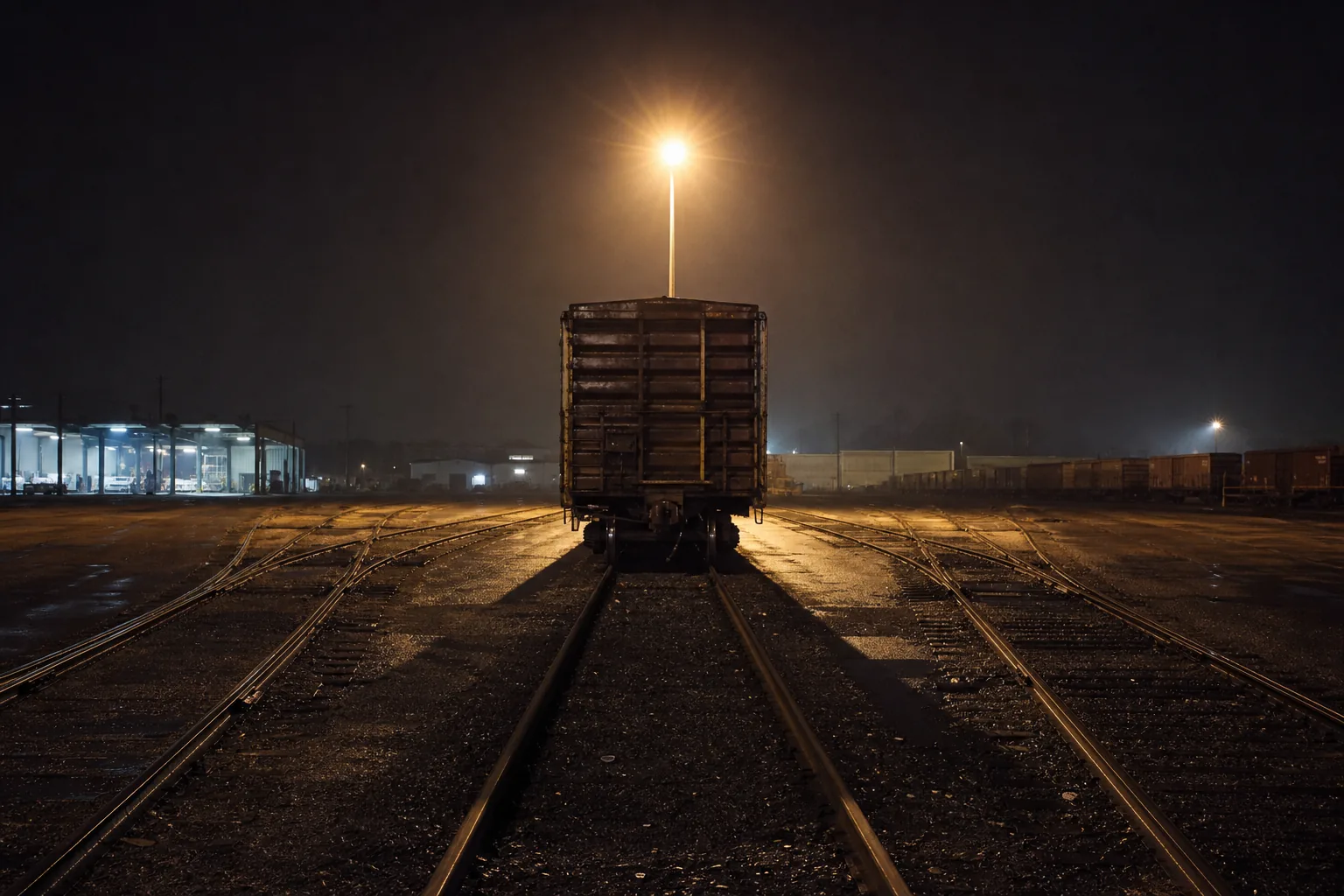
The car rolls away from the train it arrived with, slowly enough that you hear the couplers settle, then fast enough that the gap starts to look deliberate. A boxcar is being pulled over the crest. Behind it the manifest it came in under gathers itself and leaves without it, and ahead the tracks divide under the yard lights.
It has stopped being part of a train. It’s one thing somebody has to place.
Ferris has worked this yard for eleven years and doesn’t explain anything until you’ve watched it happen once.
“Where’s that going?”
“East,” he says.
“East is the consignee?”
“East is the next yard that knows how to take a train apart. You’ll ask me that four more times tonight.”
Your car started at a siding, and that’s the first fact you lose when you say rail freight as though a train pulls up at a factory door.
The industry track is a private spur. Your empty got spotted there, the side doors came open, and cement went in on pallets, in bags, on a forklift. The local crew didn’t arrive when your last pallet was ready — it came on its scheduled local turn, because the local was collecting other people’s cars too.
On the side of your car the stencil reads thirty-nine feet ten and a half, and Plate C. It’s a boxcar built for palletised cement. When the light catches it you can see the plug door sitting flush against the side, and that tight seal is for weather and pests.
It is not a bottom gate.
There’s no hopper pit waiting at the far end of this. There’ll be a dock, a forklift, and people taking bags off one unit at a time. The commodity is cement. The handling form is not, and the handling form is what chose the car.
Before the local took it, somebody made your car legible. The waybill names the shipper, the consignee, the commodity, the routing and the billing instructions. It’s electronic, and it travels with the car’s identity rather than inside the boxcar with the cement.
A car can pass through darkness, rain, a new railroad and four different trains. The waybill stays the thing that tells the next person where it’s meant to go.
The local brought it in here alongside cars carrying things that don’t resemble cement and won’t travel with it past tonight.
The yard can hump your car over the crest or flat-switch it on level track, and at the useful point the work is identical. Separate it from the arrivals. Sort it by destination block. Couple it to strangers you’ll never hear about. The next train is a manifest, a way freight, and it isn’t going to your consignee either.
You watch the boxcar settle into another cut. It has already changed trains once. For a carload moving any real distance it may do this at more than one classification yard, coming in behind one set of locomotives and leaving behind another, waiting on whatever queue the yard is running that day.
“That’s why nobody gave you a time,” Ferris says. “You got a range.”
Line-haul speed is only one part of the answer. The rest is switches, crews, blocks, and other people’s cars that reached the same yard with nowhere else to be.
A manifest train is a temporary agreement among cars. It holds for exactly as long as their next yard is the same one. At that yard the agreement ends, and your cement car goes back to being an individual problem, and you start the night over.
There’s another way to move freight that makes this whole yard look unnecessary, and it’s on a screen in the office.
A fixed consist. A hundred cars, often more. One origin, one destination, one commodity. A coal unit train leaves a mine loop, often loading while the cars keep rolling under the chute, and runs to a power plant without ever seeing a yard like the one you’re standing in. Its consist isn’t an agreement for one leg. Its consist is the job.
That train may be built from open hoppers — bottom-discharge structure, no roof, because coal takes rain without complaint. One aluminium open hopper in the catalogue holds something over four thousand three hundred cubic feet.
Or it may be built from aluminium rotary gondolas, the bathtub cars with twin longitudinal tubs running the length of the body. A gondola has no floor gates at all. It unloads from above, by being turned over in a rotary dumper.
“Then how does it stay in the train?”
“Rotary coupler.” He doesn’t elaborate, so you work it out watching the screen: a fitting that lets the car turn without being uncoupled from the car beside it.
The coal doesn’t care whether the body underneath it has sloped hopper bays or a gondola’s tubs. The unloading plant cares a great deal, because the rotary cycle is built around one of them. From where you’re standing you’d call both of those trains hoppers. At the dumper, the distinction is still there and still expensive.
Your boxcar’s work is nothing like that. Bulk cement belongs in a covered hopper — roof above, discharge equipment below, dry powder coming out through lines or gates, into a terminal built to receive it.
The bagged cement in your car will use none of that equipment. At the end of the trip the plug door opens and a forklift comes forward. The word cement never selected this car. The bag did.
At interchange, the manifest stops being enough.
The next railroad is on the other side of a line that looks like ordinary track to you right up until somebody has to accept a car across it. The delivering carrier tenders your boxcar under AAR interchange rules. The receiving carrier inspects it for mechanical compliance before it goes anywhere near their consist.
If that inspection fails, the car can be refused or held for repair. The cement stays exactly where it is. The waybill stays true. Your trip has stopped anyway.
There’s a second edge to that acceptance and it makes no noise where you can hear it. Car-hire liability moves through the Liability Continuity System, and the timestamp matters, because a private or foreign-owned car costs money the whole time somebody else is holding it. The rate combines time, mileage and appurtenance components in the CHARM file. A car sitting in a yard isn’t only late. It’s being charged to somebody with a name on a record.
“Accepted,” the inspector says.
The word is small. The boxcar rolls forward. Custody has changed and car-hire responsibility has changed and there’s no ceremony, because you cannot hold a ceremony for every handoff on a continent.
Your car can cross from a short line to a Class I, then to another Class I, then to a delivering short line, and pass three interchanges without anything dramatic happening to it. The work is simply checked again. Mechanical condition checked. Record checked. The railroad takes your car or it doesn’t.
The coal train never comes here to be rebuilt, and that’s the whole of its advantage.
It has no next classification point because it has no intermediate classification. The same consist runs mine to plant, unloads through a rotary dumper without uncoupling, and comes back as itself, and nobody ever asks it where it’s going. Its lower rate is not a reward for calling it a unit train.
The skipped work is the saving, and you’re watching the skipped work. A single-car manifest movement commonly costs more to move than a unit train hauling the same commodity down the same lane.
You can see that cost in the space around your boxcar. Every classification event wants yard crew time, switching moves and dwell. Every interchange wants another acceptance. Your car is never lost inside the system — it’s repeatedly made available to a new part of the system, which takes very nearly as long as it sounds.
The unit train doesn’t save time by being more important than your boxcar. It saves time by refusing the sequence your boxcar has to enter.
At the destination region your car gets sorted one last time, toward the delivering local.
It’ll be spotted at the consignee’s siding on that local’s schedule and not at any appointment you were offered. Then your free-time window opens, and the car sits while the cement comes off. After that it either answers another car order or starts an empty repositioning move, and neither one is yours. The last pallet doesn’t end your car’s route. It only frees the car for somebody else’s.
By then it will have changed trains again. The sealed plug door, the pallets, the electronic waybill, the AAR inspection, the new carrier’s timestamp — not one of them was built to make a single clean journey.
Between them they make a car that can be handed off. Somebody decided that was worth more than a car that arrives, and every yard on the continent is the shape of that decision.
Ferris is already looking at the next cut coming over the crest. Carload service was never your car trying to stay inside one train. It’s your car trying to stay legible while everything around it changes.
Check the record
Sources
- Freight Rail Operations 101: Overview and BasicsAccessed 2026-08-18
- FHWA: Freight Transportation and CompetitivenessAccessed 2026-08-18
- Railinc Interline Settlement System Front MatterAccessed 2026-08-18
- Railinc Car HireAccessed 2026-08-18
- Railinc Car Hire Deprescription: CHRNSS Business RulesAccessed 2026-08-18
- AAR Circular OT-10Accessed 2026-08-18
- Surface Transportation Board: Demurrage & Accessorial ChargesAccessed 2026-08-18
- TrinityRail BoxcarsAccessed 2026-08-18
- TrinityRail 3,230 Pressure Differential Covered HopperAccessed 2026-08-18
- TrinityRail Open HoppersAccessed 2026-08-18
- TrinityRail GondolasAccessed 2026-08-18