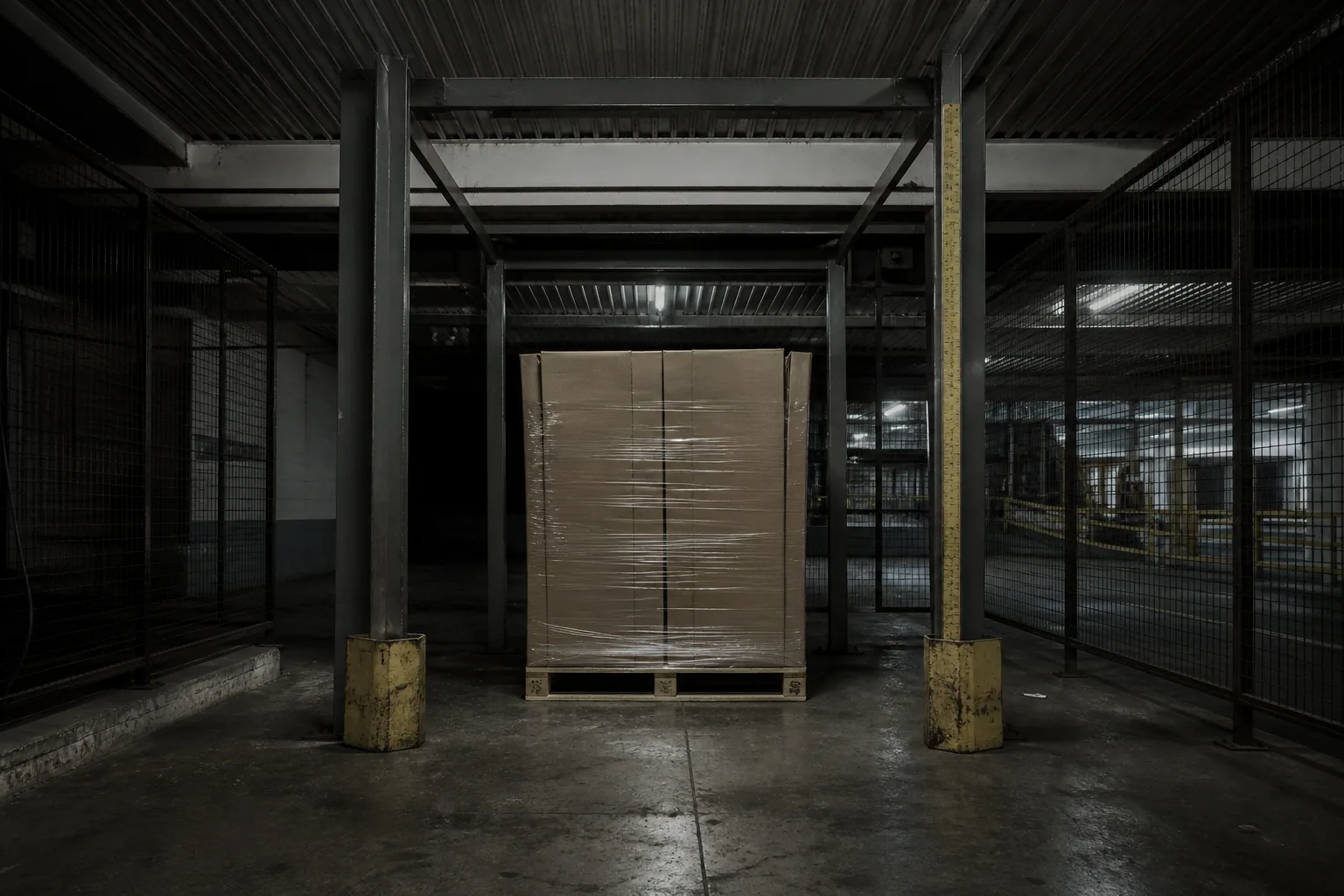
Your pallet is waiting under the measuring frame when you get back from the scale. A carton, then another carton, then a clean square of corrugated keeping the top layer from taking the straps directly. The stretch wrap shines under the dock lights, and at the corners the paperboard protectors have made a hard outline around what would otherwise be a soft stack.
Your product made the trip. No broken fittings on the floor, no bowed lower cartons, no film hanging loose off one side. That’s what the packing work was for, and nobody here is going to look inside for proof of it.
“All the way in,” the dock clerk says.
You push it in. The display gives you the weight first — a thousand pounds — and then the frame takes the rest while the load just sits there, pallet and cartons together, four feet by four by four.
Nobody asks what your product measures without its protection.
“That’s not the unit,” she says, when you ask.
The carrier measures what was tendered, and the list is shorter and crueller than you expected.
Length, width, height. Total weight. Your pallet counts. Your packaging counts. Your dunnage counts, and blocking and bracing count if they’re in there. The carton doesn’t get smaller because the air inside it has a job.
That job is obvious at a damaged dock and almost invisible here. Dunnage belongs at the unsupported top layer and at the faces meeting the direction of travel, where there’s no adjacent load to take the force alongside it. Honeycomb paperboard gives an exposed corner rigidity without demanding the cube a thicker wall would.
Foam-in-place and moulded foam close around a product where air bags or loose fill won’t. Placement beats total quantity every time, and the package that survives is usually the one with material in the right places rather than the one with more of it.
But the right places have edges, and this is the part that costs you.
Your corner protectors make the stack square. The square makes the outer envelope real. A piece of dunnage inside a carton spends cube once. A protector, or a wrap that bulges, spends it a second time at the pallet face, where the frame can see it.
The cartons are column-stacked, corners standing over corners, a straight load path running down through the box walls.
It’s the strong pattern for compression and the quick one to build. It has very little to say against lateral movement once the wrap starts to relax. An interlock layer would bridge the seams underneath and hold up better against racking and leaning, but you’d give back some of the clean vertical transfer the column pattern buys you. No pattern gets to be best without a route attached to it.
You can see why the packing crew went the way they did. Under repeated braking, acceleration and cornering, stretch film gives up containment force a little at a time. A load can look right at origin and arrive with film tight on one side, slack on the other, and cartons on the floor where the leading face used to be. Column stacks turn up in those shift failures for a reason. The film was never a permanent wall and nobody promised you it was.
Cube means different things depending on who’s holding the tape, and the clerk makes you learn both numbers.
In a well-planned trailer or container, product and packaging commonly take up seventy to eighty-five percent of the available volume. In a warehouse, where aisles and clearance have to exist, the comparable figure runs twenty-two to thirty.
“Those aren’t two versions of one number,” she says. “Don’t ever quote me one in the other’s meeting.”
Move a year of freight from sixty percent trailer utilisation to eighty and you cut the trailer-load count by roughly a quarter. That’s why somebody upstairs keeps asking whether your protection can come in closer. It’s also why nobody sensible asks the carton to become empty.
The small air spaces in there are doing more than one thing at once. They eat trailer cube when the pallet grows around them. They cost you dunnage. And they let your product travel further when something shocks it.
The packing decision was never to remove void because void is morally offensive. It’s to put in only the protection the product and the route actually require, then make the outside of the unit load as close and regular as the work allows.
Packaging keeps its own record of old arguments, and one of them is about weather.
Corrugated loses compression strength under sustained load and as humidity climbs. A safety factor that holds in a climate-controlled dwell of no more than thirty days sits somewhere between two and a half and three. A humid or long-transit route wants three and a half to four.
Your carton can test clean, then sit in a wet and longer dwell carrying a load the test never asked it to carry. The failure looks like a weak box. Sometimes the failure is a route that arrived after the box had already been decided.
The test names aren’t magic words either. ASTM D4169 carries eighteen numbered distribution cycles and three assurance levels, the first most severe and the third least, with ten lettered schedules combining handling and drop, stacking compression, vibration, low pressure and concentrated impact into whatever sequence a route needs. ISTA 3B is the general simulation for LTL.
Your package can pass a drop screen and still take vibration badly, because a trailer deck keeps moving long after the one hard impact is finished. Test it for the work it does. Not for the work it might have done.
The clerk turns the screen so you can watch the calculation happen.
Your four-foot sides become inches before they go in. Length times width times height, divided by seventeen twenty-eight. The result is sixty-four cubic feet. The thousand pounds off the scale goes over that.
Fifteen point six pounds per cubic foot.
“Fifteen to under twenty-two and a half,” she says. “Class 70.” She’s reading a band. She isn’t judging whether your cartons look expensive or fragile, and she doesn’t ask what’s in them.
For density-rated freight, fifty pounds a cubic foot or more is Class 50. Thirty-five to under fifty is 55. Thirty to under thirty-five is 60. Then the bands keep stepping down — twenty-two and a half, fifteen, twelve, ten, eight, six, four, two, one — and below one you’re at Class 400. There are thirteen of them now where there used to be eleven.
The full NMFC scale runs eighteen classes, fifty through five hundred, and density no longer uses all of them. Classes 77.5, 110, 150, 200 and 500 are absent from the current density lookup and have not disappeared from the classification, because a specific NMFC item can still assign one.
Which means the screen can be perfectly right about the arithmetic and perfectly wrong about the item, if the commodity description or the packaging sub-item is wrong.
This is where your load changes shape on paper without moving an inch.
It was cartons protecting a product while you were building it. It’s sixty-four cubic feet while it’s being rated. The void inside it isn’t an abstraction any more — it’s part of the exterior space a carrier has to find room for beside somebody else’s freight.
Density is the usual answer and it was never the only one. The NMFC calls the four of them transportability characteristics: density, stowability, handling and liability.
A hazardous load stows badly beside other freight. An odd shape wastes the space around itself. A load needing special equipment or extra labour carries a handling problem while being perfectly dense. A product that leaks, crushes its neighbours, or attracts theft brings liability into the trailer with it. None of those become ordinary because a division hands them a pleasant number.
She scrolls back to the bill of lading, because a class on its own was never enough. The applicable NMFC item and sub-item have to describe your commodity and the way you packaged it — loose, crated, or palletised. Your product hasn’t changed. The way it introduced itself to a shared trailer has.
There’s a version of this argument that starts before a carrier sees anything, and she’s watched it lose every time.
A shipper measures the carton instead of the complete pallet. Leaves the pallet weight off. Uses the product’s true shape instead of the rectangular space it actually occupies.
None of that survives contact with this frame.
A carrier can also reach a different answer from its own measurement while you did the arithmetic perfectly correctly, and the reclassification still starts from the shipped configuration rather than from anything discovered inside your box.
She saves the record. Your pallet hasn’t moved. The cartons are still dry and the protectors are still doing their small useful work. The carrier now holds a weight, three exterior dimensions, a cubic volume, a density, an item and a class.
Thirteen bands and a divisor of seventeen twenty-eight came from a committee. Your packing crew spent two hours deciding where the foam goes. Only one of those decisions reaches the paperwork. Your packaging didn’t fail the product. It met the carrier, and became freight.
Check the record
Sources
- NMFTA 2025 NMFC Changes Frequently Asked QuestionsAccessed 2026-08-18
- NMFTA: What is Freight Class?Accessed 2026-08-18
- NMFTA NMFC Classification Glossary of TermsAccessed 2026-08-18
- NMFTA Announces July 19, 2025 Effective Date for NMFC ChangesAccessed 2026-08-18
- NMFTA Disposition Bulletin 1371Accessed 2026-08-18
- Fibre Box Association: How Does Stacking Pattern Impact BCT?Accessed 2026-08-18
- ASTM D4169-23: Standard Practice for Performance Testing of Shipping Containers and SystemsAccessed 2026-08-18
- ISTA 3B Overview of Procedure 3BAccessed 2026-08-18
- Old Dominion: How LTL Shipping Data Accuracy Impacts Pricing & Re-RatingAccessed 2026-08-18