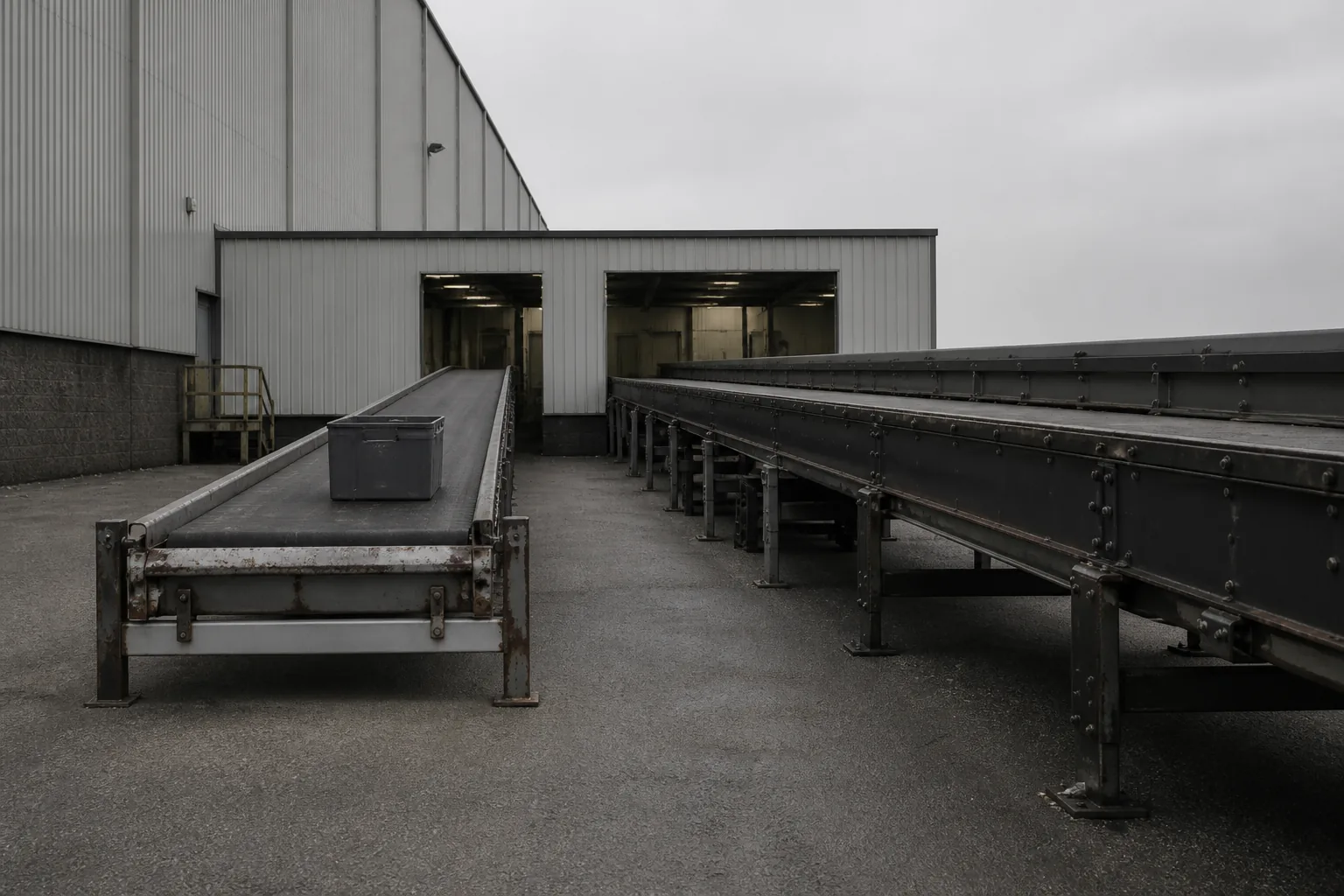
Your tote comes off receiving with a clean side and a dirty one. The clean side carries its licence plate under clear tape. The dirty side has picked up dust off the dock plate and a black scrape where it met something solid.
It’s been unloaded, scanned, matched against the advance shipping notice — item, quantity, lot — and somebody has already looked at it for damage. That’s why it’s on the powered line at all.
Reconciliation cleared it for putaway. The belt cleared nothing.
You’re standing at induction with the rest of the work coming off the dock. Cartons reach the reader in a steady file, the scanner catches the barcode, and where a barcode won’t do, RFID answers for you instead. The read names your tote and asks for a route. That’s the small point where the physical thing and the record are supposed to agree.
Past it the system has no patience at all. It has carriers, chutes, lanes, and a destination already sitting in a table you’ll never see.
The cross-belt sorter circles ahead of you, every carrier separately powered, every one able to throw its load sideways the instant it reaches the commanded place.
The board says one point eight metres a second. The same machine is rated to sixteen thousand carriers an hour, near fourteen thousand items on a day that behaves. It’ll take something a hundred and fifty millimetres long without losing it, six hundred on one carrier, twelve hundred spanning two. Your permitted weight starts at half a kilo and stops at thirty-five. None of those are promises to you. They’re the walls the normal work runs inside.
Your tote reads once. The screen changes.
It reads again.
The screen makes the short sound that doesn’t mean yes.
Behind you the normal cartons keep going, being told where to go and doing it. One heads for an AS/RS induction lane. One goes to replenishment. One is bound for an outbound consolidation route this machine knows nothing about — the same sorter makes an inbound storage decision in the morning and an outbound shipping decision after lunch, and the physical loop has no opinion either way.
Your tote has two answers where it needs one. The licence plate says one thing and the record attached to the route says another, or the route has nothing attached at all. Which of those it is doesn’t matter yet. It’s not a carton that can safely go to a chute.
“Exception,” the operator says.
The carriage takes it straight past the lane it would have used. Nothing crashes. Nothing waits for the whole loop to be generous about it. The divert drops it onto a short dead-end spur where it stops with the conveyor still running beside it.
The line didn’t fail you. It did the only safe thing available to it with an unconfirmed decision, which was to stop the thing becoming a fast mistake.
You look at the tote as though it ought to explain itself.
It’s a plastic bin of mixed SKUs. It has weight, shape, a readable label, and no authority whatsoever to choose its own address.
“So what’s wrong with it?”
“Nothing’s wrong with it. Something’s wrong about it.” Automation moves your work between stations. It has never once removed the decision waiting at the station.
“Carriage wears out, I’ve got a new one on in ten minutes,” the operator says. “That thing you’re holding isn’t a ten-minute problem.”
He lifts it off the spur and puts it on a cart marked for resolution, and that’s your tempo change, right there in the space of one movement.
The sorter made and executed its part of this in well under a second. Your tote now travels at walking speed, because somebody has to ask what was received and what was released.
At the receiving desk the ASN is open on one screen and the receipt on another. The clerk scans your licence plate again, then reads you the expected item, quantity and lot.
Without an ASN you’d be here much longer — carton by carton, purchase-order line by purchase-order line, before any of it could be accepted. You have one, so your wrongness at least has a shape.
It becomes an OS&D record. Overage, shortage, or damage. A reason code goes in and a photograph may go with it, and your tote enters no putaway anywhere while that record is open.
She turns it until the scrape sits under the light, without any urgency in the motion. Inspection belongs before release. Goods on quality hold stay apart. Goods in a carrier claim stay apart. A receipt can be standing in front of you, entirely physical, and still not be stock.
When the receipt reconciles, a directed-putaway task appears, and the system has already chosen a location from the item’s slotting profile.
Nobody asked you to improve the choice. You take the tote to the assigned location, because a directed task isn’t a suggestion, and because random storage keeps its own record and none of its own mercy.
The aisle is quieter than the sorter. A shuttle system works behind the rack, carrying other people’s totes between lifts and storage while you walk yours.
A traditional pick station can run sixty to a hundred and twenty lines an hour. A multi-order station ninety to a hundred and sixty-five, a high-performance one up to a thousand. Out on the open floor, AMRs take shelving units or totes at a hundred to three hundred lines an hour and add capacity one robot at a time.
Conveyor, sorter, shuttle, robot. Separate machines, one building. Every one of them can bring your tote to the edge of a decision, and not one of them can tell you what a full shelf means.
The location label scans. The licence plate scans.
The screen rejects your confirmation. It’s a simple refusal. Either the expected item disagrees with the plate, or the location has no capacity left for the unit.
There’s room in the next bay.
You can see it from where you’re standing.
This is the moment that makes people invent a location. Put it there. Write it down later. The tote’s already in your hands and the next task is already waiting on the screen.
“Supervisor queue,” says the voice behind you.
So you don’t use the next bay, and you don’t make an off-system placement because a bin looks empty to you. A physical move doesn’t exist to the record until it’s confirmed.
The tote goes back onto the cart and into the supervisor queue, where the location, the licence plate and the receipt can be made to say the same thing before it goes anywhere permanent. The line is slow here. It’s allowed to be slow here.
An unconfirmed tote on a shelf was never just a tote on a shelf.
It’s a bin-location error waiting for the first person who believes the screen. Weeks later a picker gets an item, a quantity and a location, and walks the aisle you’re standing in because the system says the unit is available. The bay is empty, or it holds the wrong SKU.
Then the search. The short pick. The escalation. An order that can’t be completed while its inventory is somewhere in this building. The record calls it available. The floor doesn’t. That’s a phantom stockout, and you just declined to create one.
The work spreads outward from that one quiet decision. Putaway discipline is reported to remove something on the order of forty to sixty percent of the downstream problems a facility otherwise spends its year chasing. Unassisted picking errors run one to three percent, where fully scan-verified operations can run under half of one.
None of which makes your tote less particular. A scan can confirm a match at the pick face. It can’t find an item somebody placed off-system a month ago, and it can’t make two wrong records right by having them agree with each other.
The supervisor clears the exception eventually. The tote gets placed, and this time the item scan and the location scan close together on the screen, and it becomes eligible for picking.
In a goods-to-person station the system may bring it to a stationary picker at three hundred and fifty to six hundred and fifty cases an hour. Person-to-goods runs a hundred and fifty to two hundred and fifty, because the person walks. Neither rate is a cure for a location that only exists in software.
The count happens later, and it happens with the expected quantity hidden from the counter.
That’s a blind count. You see the location, you count what’s in front of you, and only afterward do you see what the system expected. Beyond the facility’s tolerance the count gets done again, and if the variance holds, somebody goes looking for a root cause. The variance was never the failure. It’s where an older failure finally leaves a mark you can see.
Fast-moving A items get counted monthly to quarterly, B items quarterly, slow C items somewhere between twice a year and once. Roughly a fifth of the SKUs generate most of your pick activity, which is exactly why nobody leaves their errors alone for twelve months.
One bad count in one location may be a mistake. The same variance coming back in one zone is concentrated variance — a bad label, a location too small for the SKU assigned to it, a method somebody keeps repeating. Scattered variance is a different kind of trouble altogether, and the pattern decides where anybody starts looking.
The sorter is still running when you get back. There’s another carton sitting in the dead-end spur now, and normal totes are passing the opening in a hard continuous rhythm you recognise immediately.
Read, route, divert, confirm.
The machine moves a carton at one point eight metres a second. The short spur going nowhere is the part that required an engineer to admit the machine cannot finish the job.
Your tote is in the rack by now, or out at a pick station, or back through the sorter toward an order that wants it. The conveyor never found out which. It only ever carried the work to the next station.
At the queue, a person took it out of the rhythm long enough to make the record and the shelf agree. Then the building let it move again.
Check the record
Sources
- Crossbelt Sorter — Körber Supply ChainAccessed 2026-08-18
- Route Instruction Configuration — Oracle Warehouse ManagementAccessed 2026-08-18
- System Directed Putaway — Oracle Warehouse ManagementAccessed 2026-08-18
- Receive by Load — Oracle Warehouse ManagementAccessed 2026-08-18
- Shuttle System — Interlake MecaluxAccessed 2026-08-18
- ASRS 101: Comprehensive Guide — KardexAccessed 2026-08-18
- What is the difference between person-to-goods and goods-to-person picking? — SSI SCHÄFERAccessed 2026-08-18
- Inventory Tracking Best Practices — RFgenAccessed 2026-08-18
- Complete Guide to Inventory Cycle Counting Best Practices — RFgenAccessed 2026-08-18
- Cycle Count vs. Physical Inventory: Which Saves More Money? — CPCON GroupAccessed 2026-08-18