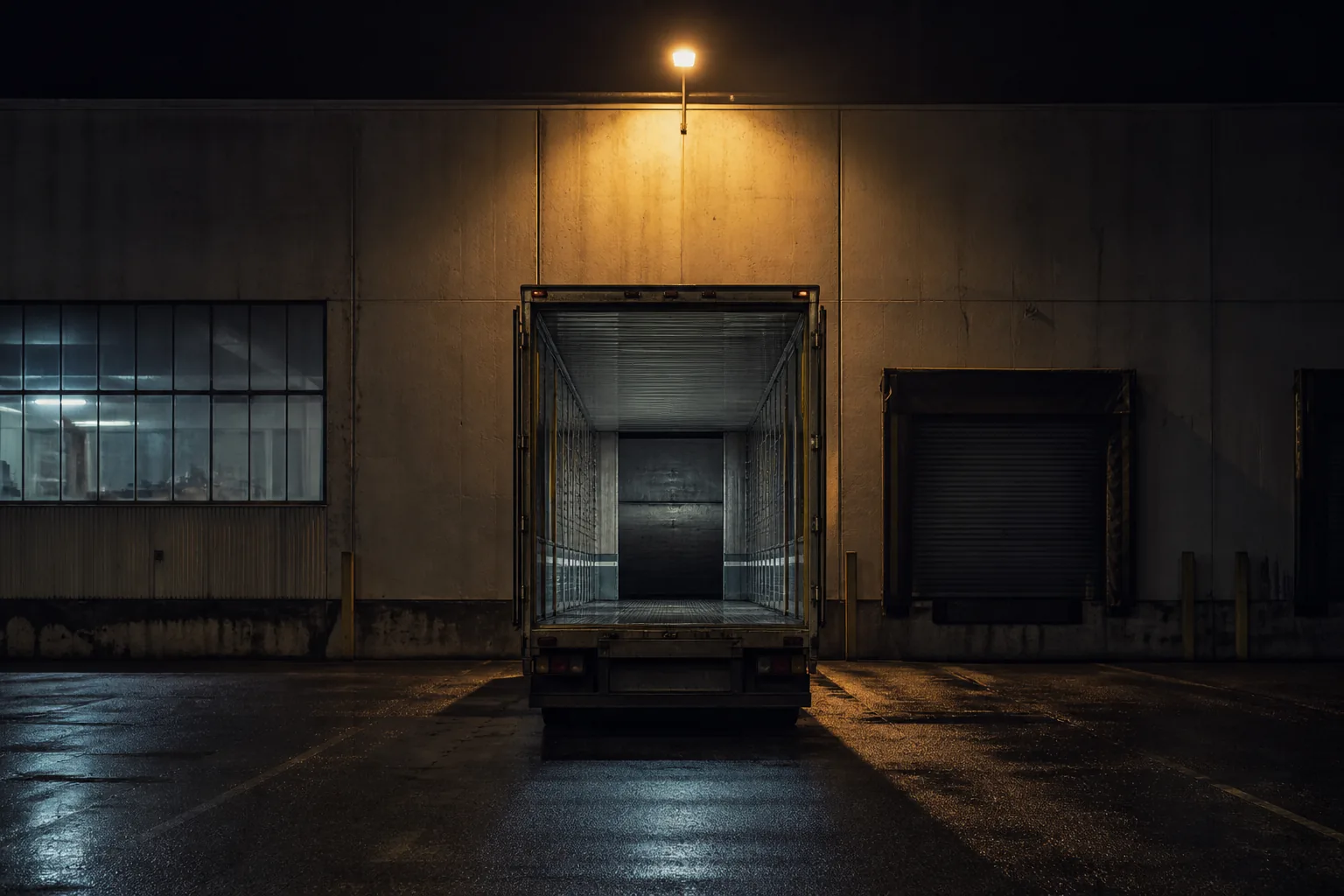
The route gets to work before you do. It’s already on the device when you climb into the cab — a numbered sequence, estimated arrivals, windows sitting calm in their little rectangles.
Your address is in the middle of it, between two others close enough by road to make the insertion cheap.
Cheap has a specific meaning here, and Nadia in dispatch makes you learn it before she’ll give you a van.
“It didn’t draw lines between pins,” she says. “It asked the road what every pair of stops costs. Then it asked what time of day you’d be doing it.”
The same drive is eight minutes at ten in the morning and twenty at five in the afternoon. The matrix knows about the divided carriageway and the turn you can’t make. It knows the road.
“So it knows the street.”
“It knows the road,” she says. “Those are different words and you’ll find out why around eleven.”
The day’s stops were never solved all at once. There are hundreds of them and dozens of vehicles behind that clean screen, so the engine built geographic clusters first, each one roughly a vehicle-day, and only then started arranging stops inside them.
It might have swept outward from the depot by angle, filling one cluster to capacity before opening the next. It might have used k-means, or a grid. You don’t get to see that part. You get your slice of the city and the order somebody made out of it.
Inside the slice it starts with a fast answer — nearest-neighbour, or cheapest insertion — and then works that answer over. Two-opt reverses a segment where a crossing wastes road. Or-opt lifts a short chain of stops and sets it down somewhere less foolish.
Your route has had arguments you weren’t present for. It won them in miles and expected minutes.
It didn’t win them cheaply enough to ignore the clock. Every candidate move met a window, and a move that shortened the route while pushing a later stop past its window got thrown out. Capacity gets the same flat treatment: weight, volume or item count counted cumulatively stop by stop, and a geographic fit that breaks the vehicle limit isn’t a fit.
“Your route’s longer than it needs to be,” Nadia says. “In raw miles. On purpose.”
“That’s a fault.”
“That’s a promise. Promises weigh something.”
The first few addresses take their cartons without requiring you to have a theory of the pavement.
A receiver opens a shutter. A hand signs. You leave, and the device advances the next stop into place, and for about an hour it feels like the route is making the street happen.
Then the road narrows into the commercial block.
Your delivery address is up there above a row of windows. So is the loading bay, painted at the curb with the kind of confidence that means somebody wrote a rule for it. There’s a van in it already, rear doors open, someone carrying crates through a side entrance one at a time.
There is nowhere else to stand without becoming a different sort of vehicle in a different sort of story.
Your optimizer has a road link and a service time. The borough has a loading-bay designation, a permit scheme, and an hour attached to that curb. None of those are inputs your route can settle by being clever, because the street has its own administrator, and your address can be perfectly geocoded and still sit on the wrong side of a legal stop.
“You can’t wait there,” the person in the bay says, not looking up from the crates.
You look at the device. Your stop is due. The next stop has a window too.
Nothing on that screen knows the van in the only legal place has a name, or that the bay answers to a local rule instead of to the distance matrix. The screen can calculate a turn. It can’t empty a loading bay.
Your vehicle passed other gates to get this far, and none of them helped.
An HGV over three and a half tonnes in London’s Low Emission Zone needs Euro VI. Short of that the day costs a hundred pounds, and below the older Euro IV standard it costs three hundred. Over twelve tonnes, driver sightlines bring the Direct Vision Standard into your cab — the required star rating, or a fitted Progressive Safe System, with a permit that costs nothing until you don’t have one and the penalty runs up to five hundred and fifty pounds, halved to two seventy-five if you pay inside a fortnight.
None of that buys you a metre of curb.
The smaller van beside you lives under a different layer again. The ULEZ takes Euro 4 for petrol cars and vans and Euro 6 for diesels up to three and a half tonnes, and a non-compliant one pays twelve pounds fifty for the day, across all thirty-two boroughs, around the clock except Christmas.
Your HGV can be legal to enter. That van can be legal to enter. Both of you can be illegal to stop exactly where the receiver’s door is.
You circle once, which isn’t the same as waiting. It costs you road time and returns you to the same occupied bay with a later clock, and on the device your planned position starts separating from your actual one.
Somewhere ahead, a window is becoming a problem before you’ve reached it.
The loop that fixes this is much smaller than the one that made your day.
It doesn’t take the whole fleet apart and redraw the city because one curb is full. It takes your current position, your remaining stops, your remaining time, and the capacity still in the back, and runs two-opt and or-opt again over only what’s left. That can finish in seconds.
A road closure triggers it. A cancellation, a same-day addition, a service time that ran long. A curb that won’t take you is just as real as any of them.
The device moves two later stops ahead of this one. It doesn’t call that a solution — it calls it a revised sequence, which you decide is the most honest thing the software has said all morning.
The new path is shorter from where you’re sitting, and the engine still checks the new clock against your remaining windows before it hands it over. It checks capacity as well. A shorter route that misses a hard window hasn’t helped anybody.
And a stop it can’t place without breaking a window or a capacity limit gets flagged unassigned rather than squeezed in until the rest of your day collapses around it.
You pull away with the cartons still in the back. The receiver hasn’t changed. The road distance hasn’t changed. Only the fact of the curb has entered your route.
By the time you come back the bay is clear, and the delivery takes less time than the circling did.
The receiver signs. You load the empty handling equipment and watch the device close the stop as though it had always been in the right place, which is its one real talent.
Finding the address was never the question. A map finds an address. A route orders it among the others. The last metre belongs to a separate system that wants to know what vehicle is present, what hour it is, what the sign says, and whether the only legal place is already occupied.
Your sequence was optimized. The curb has no opinion about that.
Cities do sometimes move the work away from the question. An urban consolidation centre or a logistics hotel takes freight before the core and brings it back through fewer local stops on one operator’s fleet. That doesn’t make a prohibited curb legal. It cuts down how many separate carriers have to hold the same argument with the same bay.
Time is the other lever. In New York’s congestion-pricing zone south of 61st Street, small trucks and buses pay fourteen dollars forty in standard hours with E-ZPass and large ones pay twenty-one sixty, while overnight the same vehicles pay three sixty and five forty. That’s an instruction that never uses the word: bring freight when the commuters aren’t trying to use the road.
London gives you no such release. The ULEZ and LEZ charges hold flat for twenty-four hours, so whatever time incentive exists has to come out of a borough’s own loading-bay hours. You can move your work into the dark and still meet the same Euro class, the same permit rule, and find the bay occupied anyway.
By evening you know exactly what the device can do. It builds the pairwise costs. It clusters, sequences, refuses a seductive short path because a window would break, rebuilds the rest of the work from wherever you happen to be standing, and tells a dispatcher when something needs a person.
It cannot reserve the bay ahead of you. It cannot turn a zone permit into a curb permit. It cannot carry your cartons through a door while the only legal place to stop belongs to somebody else.
A borough drew that bay. A different office set its hours. Neither of them has ever met the algorithm that sent you here.
Your sequence ends at the address. The delivery starts there, and nobody has written software for the part where you ask.
Check the record
Sources
- Get a route matrixAccessed 2026-08-18
- Vehicle RoutingAccessed 2026-08-18
- Configure timeouts and deadlinesAccessed 2026-08-18
- London’s air quality schemes and Congestion ChargeAccessed 2026-08-18
- Ultra Low Emission ZoneAccessed 2026-08-18
- Direct Vision Standard and HGV Safety Permit SchemeAccessed 2026-08-18
- About the Congestion Relief Zone tollAccessed 2026-08-18
- Waiting and loading traffic ordersAccessed 2026-08-18
- The future of last-mile deliveries: Understanding the local perspectiveAccessed 2026-08-18
- Last mile urban freight in the UK: how and why is it changing?Accessed 2026-08-18