The screen at the cargo terminal gives you a departure time in bright, untroubled letters, close enough to make a person walk faster.
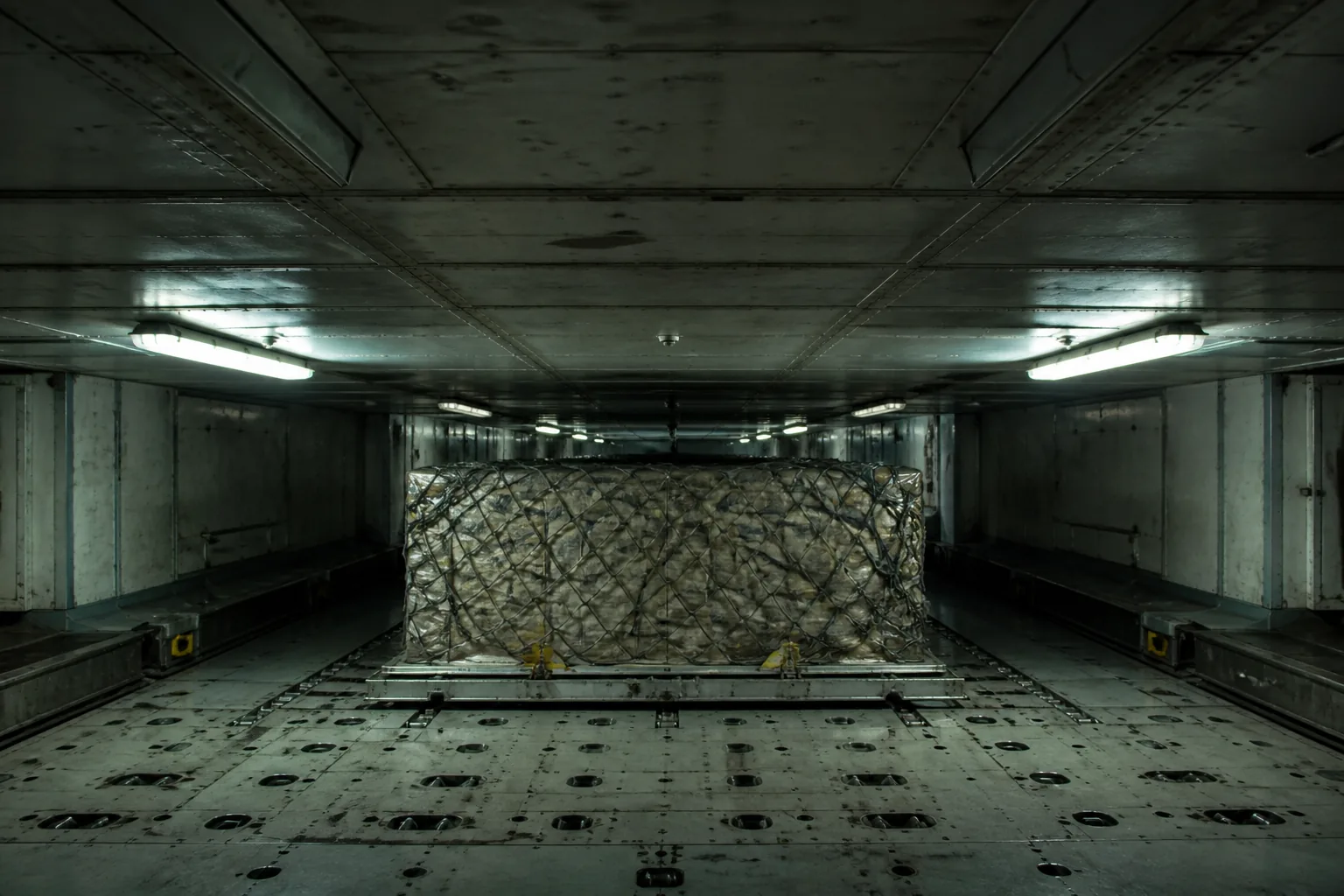
Your ULD doesn’t move at all. It waits under the contour frame with its net drawn tight, its corners dull from other people’s hands, its freight hidden behind aluminium and fabric. The aircraft is ready to be an aircraft. Your freight is still a question on the ground.
The booking has a routing, a flight number, and a cargo cutoff, and the cutoff is the only one of the three that matters to you now. It commonly falls four to six hours before departure, depending on the airport and on whether your forwarder built the ULD or sent loose freight for the handler to build.
The screen keeps showing the later time. The terminal has been working to the earlier one all afternoon.
“Cutoff,” the handler says, without looking up. “Not departure.”
You have a booking confirmation in your pocket. It confirmed space against this cutoff. It did not put your ULD in a hold.
A booking can sit on a desk for weeks before the intended flight. At a terminal it becomes something much smaller — a pallet, an outline, a scale reading, and a deadline that started closing before you arrived.
The first work happened before any of this.
Individual pieces became a unit load device, matched against the booking list and the pre-manifest. They were weighed. Length, width and height were taken in centimetres.
The greater of your actual gross weight and the volume you get by multiplying those and dividing by six thousand became the chargeable weight. Once the build closes, that isn’t an estimate any more. It’s the number your freight has to live with.
Somebody points at the dimensions on the sheet. Somebody else points at the chargeable weight. They aren’t arguing, and they aren’t the same kind of number either.
A compact, heavy ULD gives the airline its gross weight. A light, swollen one gives it its volume. The airline bills the higher. That’s why the build happens before the document. Your freight has to become one thing before anybody can describe it as one thing.
Only then does the air waybill turn up. Your forwarder issues a house AWB to the shipper. The airline issues a master AWB to the forwarder. Both take the chargeable weight and routing the build already fixed.
On eligible lanes the record can be an e-AWB under IATA Resolution 672, and the screen changes nothing about the ULD under the frame. The electronic record follows built freight. It has never built any for you.
The scale platform is set into the terminal floor. The ULD gets pushed across it slowly enough that every wheel announces itself.
The handler watches the reading settle, and this is the reading the airline cares about. Where it differs from the figure you declared at booking, your dispute has just found its address. Your booking number was useful. Her scale is billable.
Then the ULD goes under the contour frame, which has no interest in whether you’re booked. It asks one question. Does the loaded shape fit the aircraft door and the hold geometry?
A corner of packaging standing proud of the contour isn’t a detail. A net gathering wrong isn’t a detail. The check belongs here because the aircraft settled what shape of cargo it takes long before your freight existed.
“Weight. Contour. Documents,” she says. “Then security.”
The AWB and manifest go against the built unit, and it isn’t a reading exercise. Piece count, routing and chargeable weight have to describe the thing on the scale and under the frame.
Security runs inside the same narrowing window. Freight from a known consignor, or already screened by a regulated agent, moves through that part faster than freight the handler has to screen herself. Your cutoff doesn’t become generous because a screening queue is long.
You look at the departure time again. The aircraft still has time. Your cargo has considerably less.
Which is why a booking never guaranteed the departure printed beside it. Fail weight, contour or documentation and the ULD comes off and gets rebuilt. Run out of time before cutoff and it rolls to a later flight. The original aircraft can leave exactly when it planned to. Nothing about that departure proves your freight went with it.
On the far wall somebody has left a terminal presentation running on a monitor with the brightness down.
There’s a figure for Incheon — five million tonnes of annual capacity after its third phase completed. Underneath, another figure: closer to two point nine million tonnes actually handled in 2024.
Capacity is a shape somebody built around future work. Throughput is the work that turned up. Neither one is a lane through this contour frame.
The handler catches you reading it.
“That’s the airport,” she says. “This is the shipment.”
She’s right, and it’s the most useful sentence anybody says to you today. An airport can have room in an annual accounting sense and still contain one ULD that has missed the only cutoff relevant to it. Built capacity doesn’t reach backward into your afternoon and make a late tender early. Realised throughput doesn’t make your contour smaller.
The monitor changes to Anchorage, which sat fourth in the world for cargo tonnage and has since been ranked higher. It’s a genuinely enormous number, and almost none of it is Alaskan.
It’s freighters crossing the Pacific and stopping for fuel, trading tank capacity for payload capacity, with FedEx and UPS and Atlas Air all working the ramp. The tonnage is completely real. It was never a demand order waiting on a dock.
So the terminal keeps its own clock, and now you understand why. Airport figures can count freight that stopped to refuel. They can count capacity that arrived years before the cargo. They can count work that was pushed away from somewhere else entirely.
At East Midlands, DHL and UPS and FedEx run a hub outside Heathrow’s runway capacity and the London curfew pressure — Heathrow’s runways sitting near ninety-eight percent utilised. Heathrow moves several times the freight tonnage. The smaller airport isn’t operating a smaller rule. It’s the same rule, continuing somewhere the primary gateway had room to let it continue.
The figures cross the screen and vanish. Your ULD stays under the frame. A ranking is not an acceptance scan. A capacity is not a tender.
The handler crouches at one corner of your ULD, and you can see the package edge sitting past the line of the frame. It’s barely anything. It’s enough to stop the work.
She points at it once. “Off. Rebuild.”
No alarm goes off. The aircraft doesn’t wait for an explanation from anybody. The net comes loose, the offending piece comes down, and the shape either becomes possible or it doesn’t. Your cutoff was never a punishment. It’s the point past which the terminal’s next sequence has no room for this one.
The rebuilt unit goes back to the scale and the reading settles. Back under the frame, and the curve clears. The AWB and manifest match it again. The security status is found.
Every part now says the same thing from a different direction, and that’s what acceptance actually is. Not confidence. Not a booking email. Several separate checks that have stopped refusing your freight.
She scans it into the airline’s custody with time in hand, and the ULD leaves your control without any drama at all.
A tug takes it out toward the aircraft, where it will be loaded, flown and unloaded with fewer handoffs than it took to get across this floor. Nothing changes hands at altitude. The flight is the short part. It was always going to be the short part.
At destination a ground handler breaks the ULD down and reconciles pieces and weight against the AWB before releasing anything to the consignee’s forwarder or broker. If a piece is missing, if a weight disagrees with the manifest, if damage shows, the record starts there — and under the Montreal Convention written damage notice has to be given within fourteen days of receiving the cargo.
The aircraft can’t settle that one later either.
Somebody set a cutoff hours before a departure so that a shape could be checked against a door, and every tonnage figure on that monitor was accumulated by shipments that made it.
The tug goes through a door and out of sight. The board changes to another flight.
Somewhere behind you a ULD that didn’t clear its contour is being rolled into the next available cargo flow. The aircraft left on time. Its freight moves when the ground decides it can.
Check the record
Sources
- IATA — Air Cargo Tariffs and Rules: What You Need to KnowAccessed 2026-08-18
- IATA Resolution 672: Form of Multilateral E-Air Waybill AgreementAccessed 2026-08-18
- IATA — e-AWB Standard Operating Procedure (Guangzhou)Accessed 2026-09-18
- Montreal Convention — Full TextAccessed 2026-08-18
- ACI World — Busiest Airports in the WorldAccessed 2026-08-18
- Incheon International Airport Corporation — Phase 3 Construction ProjectsAccessed 2026-08-18
- Incheon International Airport Corporation — 2024 International Traffic ResultsAccessed 2026-08-18
- FAA — Preliminary Calendar Year 2025 All-Cargo Landed WeightAccessed 2026-08-18
- UK Civil Aviation Authority — Freight 2014–2024, Table 13.2Accessed 2026-08-18
- Dubai Airports — Who We AreAccessed 2026-08-18