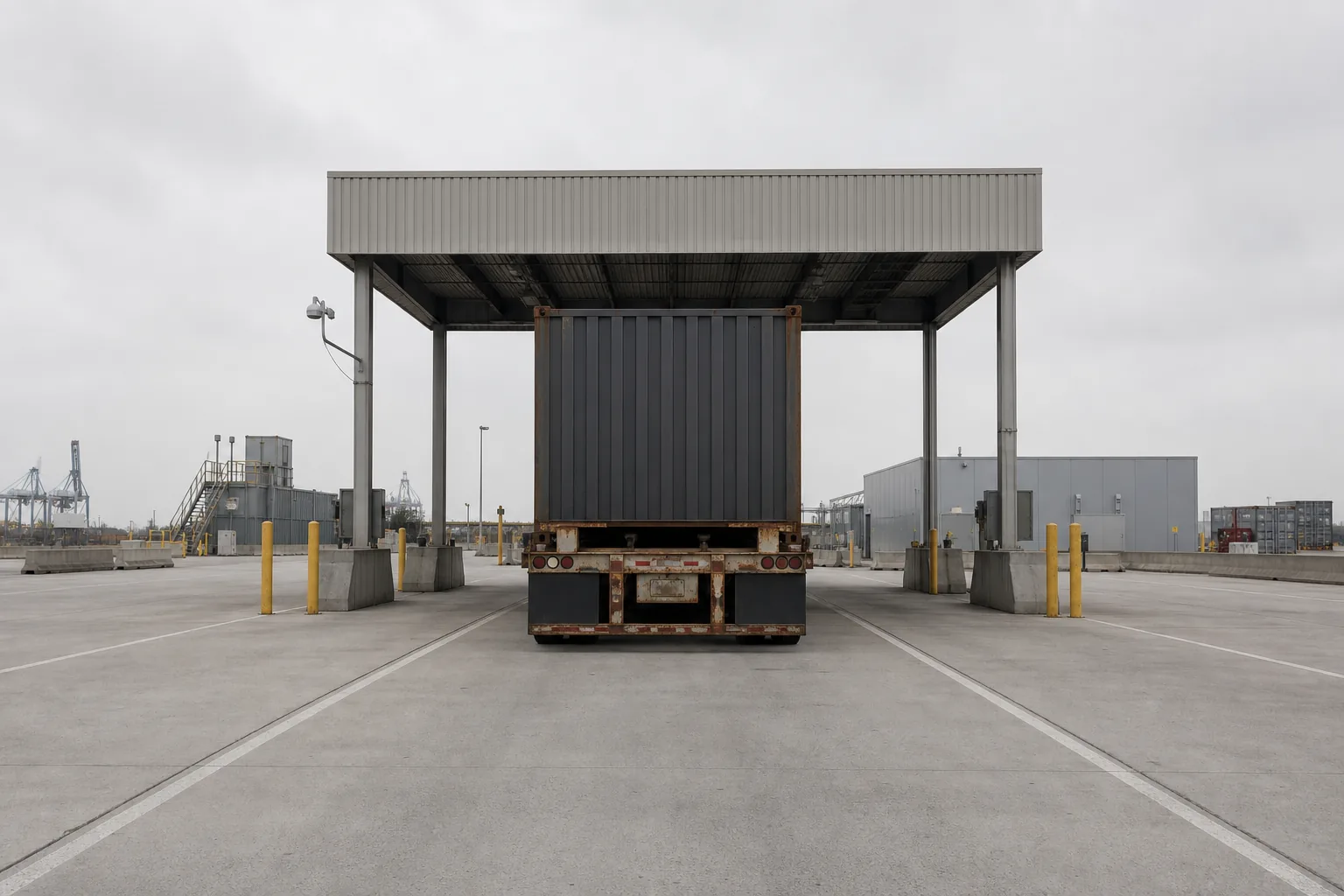
The ramp is awake before the road is. Floodlights hold the pavement flat. Beyond the fence the containers sit in rows with their doors turned away, and the cranes move them without pausing to consider who paid for the movement.
On your side, the public road waits with its own rules. Between the road and the crane yard there’s a gate, and at the gate your box stops being merely cargo.
You’ve brought a tractor and a release that says a container is available. That’s enough to make sense of the trip. It’s nowhere near enough to make sense of the equipment. The container belongs to somebody. The chassis belongs to somebody, possibly not the same somebody. They show up together often enough to look like one machine.
The paperwork has never once made that mistake.
The gate screen takes your carrier identification first. It doesn’t ask whether the move feels ordinary. Most North American interchanges run under the Uniform Intermodal Interchange and Facilities Access Agreement — the UIIA, administered by the Intermodal Association of North America — and it covers an estimated ninety-five percent of them. To the screen this is old news. At most ramps a carrier that hasn’t signed the UIIA doesn’t pick up equipment, and there’s no smaller conversation at the window that repairs that.
“You’re on the list or you’re turning around,” the attendant says. She isn’t threatening you. She’s reading.
The published figures run to nearly thirteen thousand motor carriers and sixty-odd equipment providers. The only number that concerns you is the one sitting beside your equipment number, where the system has already decided whether this carrier may take it.
She reads your release and then looks past you at the line, which teaches you something before she says it.
A lift can be working and a ramp can still be unable to let the work through. The crane yard has a design capacity. Usable capacity is a different animal — what the place can actually process while equipment, ground space and the rail network behind it are all behaving badly at once.
“Cranes aren’t your problem this morning,” she says.
Somewhere upstream a classification yard can be holding cars longer than it should. Somewhere closer the chassis pool can be empty. Through the shortage of 2021 and 2022, terminals with plenty of lift capacity had railcars to unload and nothing with wheels to take the containers away. Ground space filled. At some port terminals container dwell reached thirty to sixty days.
A crane can’t lift a box into a place that doesn’t exist.
She points you into the inspection lane, where your chassis is waiting under a container and looks complete from the cab. That isn’t the point. Before it becomes yours for the road it has to become yours on paper.
The receipt comes out with a sound like a small argument ending. Across the top: Equipment Interchange Receipt. EIR.
You’ll meet the same record four times — chassis pickup, container pickup, chassis return, container return. Each one records condition, existing damage, and the exact time of the transaction. None of them says the equipment is good. Each says what somebody was willing to write down at the moment custody changed.
There’s a scrape on the chassis frame. She has already marked it on your outbound EIR.
You look at the mark, then at the scrape, then at the time printed beside the transaction, and the order of those three things is the whole lesson. A damage note present on the outbound receipt and absent from the inbound one can support a finding against whoever held it in between.
“That’s not a courtesy form,” she says.
“It looks like a courtesy form.”
“It’s a before picture with a clock on it. Keep the copy. Keep the time.”
The EIR is your condition record and it’s also the gate record that later shows when the interchange happened. One piece of paper settling two arguments that will arrive wearing completely different clothes. When equipment billing gets challenged, that timestamp and that damage note are the only things still speaking after everyone who stood in this lane has forgotten the weather.
She tells you to couple under the box, and the moment you do, the distinction goes quiet and expensive.
The chassis becomes road equipment. The container becomes a sealed load. The UIIA treats the interchange period as a period of responsibility rather than an informal favour between a ramp and a truck.
Through that period you agree to defend, hold harmless and indemnify covered parties for specified claims arising out of your use of the equipment or its presence at a facility. The agreement also carves out exceptions for some damage caused by the indemnitees’ own negligence or intentional acts. Nobody raises their voice about any of this, because raising your voice has no effect on it.
Your carrier is carrying commercial automobile and general-liability cover of at least a million dollars per occurrence on each policy, with the equipment provider named as an additional insured. The equipment doesn’t have to be worth that for your period of custody to cost more than the load looked like it was worth at the gate.
You pull forward. The timestamp stays behind on the gate system and rides with you in the copy folded beside the seat.
A clock starts for the chassis. A different clock starts for the container. They left together. Neither one promised to expire with the other.
Free time isn’t a favour somebody extends because your road has been slow.
It’s the number of days you may hold equipment before charges begin, set by the equipment provider’s tariff. A UIIA-governed chassis pool commonly allows three to four working days depending on what kind of container it’s carrying. Your container’s free time comes from the ocean carrier’s or the railroad’s local tariff instead.
Two tariffs. Two clocks. One truck.
Neither of them has to look urgent on your first day, and that’s exactly how people get caught. The chassis can sit comfortably inside its allowance while the container reaches the end of its own. The container can wait without drawing container charges while the chassis quietly keeps adding days. Nobody at the ramp is going to combine them for you for the sake of a cleaner story.
After free time the chassis commonly draws per diem, a daily charge for holding interchanged equipment. The container or trailer more often brings the word detention. The two words are close enough to be confused by anybody who doesn’t have to answer the invoice, and the tariffs behind them are not close at all.
Your EIR time is where both explanations go looking for the beginning.
You make the delivery, and then the return turns out to be a second gate problem.
The chassis has to come back. The container has to come back. The ramp may take each at a different moment, because they’re separate pieces of equipment making separate returns, and each return produces its own EIR with its own condition record and its own exact time.
The scrape is still on the frame. You make sure it’s on the paper before the receipt closes. Outbound mark and inbound mark agree. Nothing has become right by being right. It has only stayed legible, and legible is the entire comfort this system offers you.
Sometimes the invoice comes anyway — per diem, detention, repair, maintenance. The UIIA provides a binding-arbitration process administered by IANA for covered charges after the applicable dispute process runs, and where a charge never goes to arbitration the parties keep their remedies under law. The agreement that let you onto the ramp had already marked out the room where the argument would happen.
Then your copies matter again. The gate time. The outbound condition. The inbound condition. A record of a closed gate, if there was one. A record of the chassis pool, if the terminal had lift capacity and still couldn’t release equipment. Your leverage here is almost entirely evidentiary. The receipt is small because it has to fit in a cab. Its consequences were never under that restriction.
Not every gate beside another gate is the same gate, and you find that out the expensive way.
CenterPoint Intermodal Center is one name over two separately operated terminals — BNSF’s Logistics Park Chicago and UP’s Global IV. They sit on adjoining land. Each holds its own FIRMS code and its own gate system, and whether anything passes between them on site is a question for the terminals rather than for the gate.
A container on one railroad’s ramp doesn’t become available to the other by being nearby. It leaves one property and enters the other like any drayage move you’d plan from scratch.
Spoken of as one development it runs to more than fifteen hundred acres. At the gate, acreage means nothing. Your container is inside one terminal or it isn’t, and the gate rules and chassis pool follow that answer alone.
So you learn to ask which ramp before you ask where the ramp is.
A brand can be one thing on a map and two things at a gate. A crane can keep lifting while the chassis pool keeps the exit shut. A container and a chassis can cross one painted line together and start two clocks that will never agree again.
Two railroads ran their fences up against each other and agreed on nothing about crossing them. A truck works out the difference at four in the morning.
At the public road the container settles behind you and the gate has nothing further to say. You’ve got the load, the chassis, and an EIR carrying a scrape, a time, and a custody record that keeps running long after the floodlights go out of the mirror.
Somebody is at that window right now with a release and a tractor, learning it in the same order.
Check the record
Sources
- UIIA homepage — Intermodal Association of North AmericaAccessed 2026-08-18
- Uniform Intermodal Interchange and Facilities Access Agreement, effective May 5, 2026Accessed 2026-09-18
- Detention and Demurrage — Federal Maritime CommissionAccessed 2026-08-18
- FMC Publishes Final Rule on Detention and Demurrage Billing PracticesAccessed 2026-08-18
- CenterPoint Intermodal Center, Joliet/Elwood, IL — park mapAccessed 2026-08-18
- Joliet Intermodal Terminal (Global IV) brochure — Union PacificAccessed 2026-08-18
- Driver Dispatcher Services — BNSFAccessed 2026-08-18