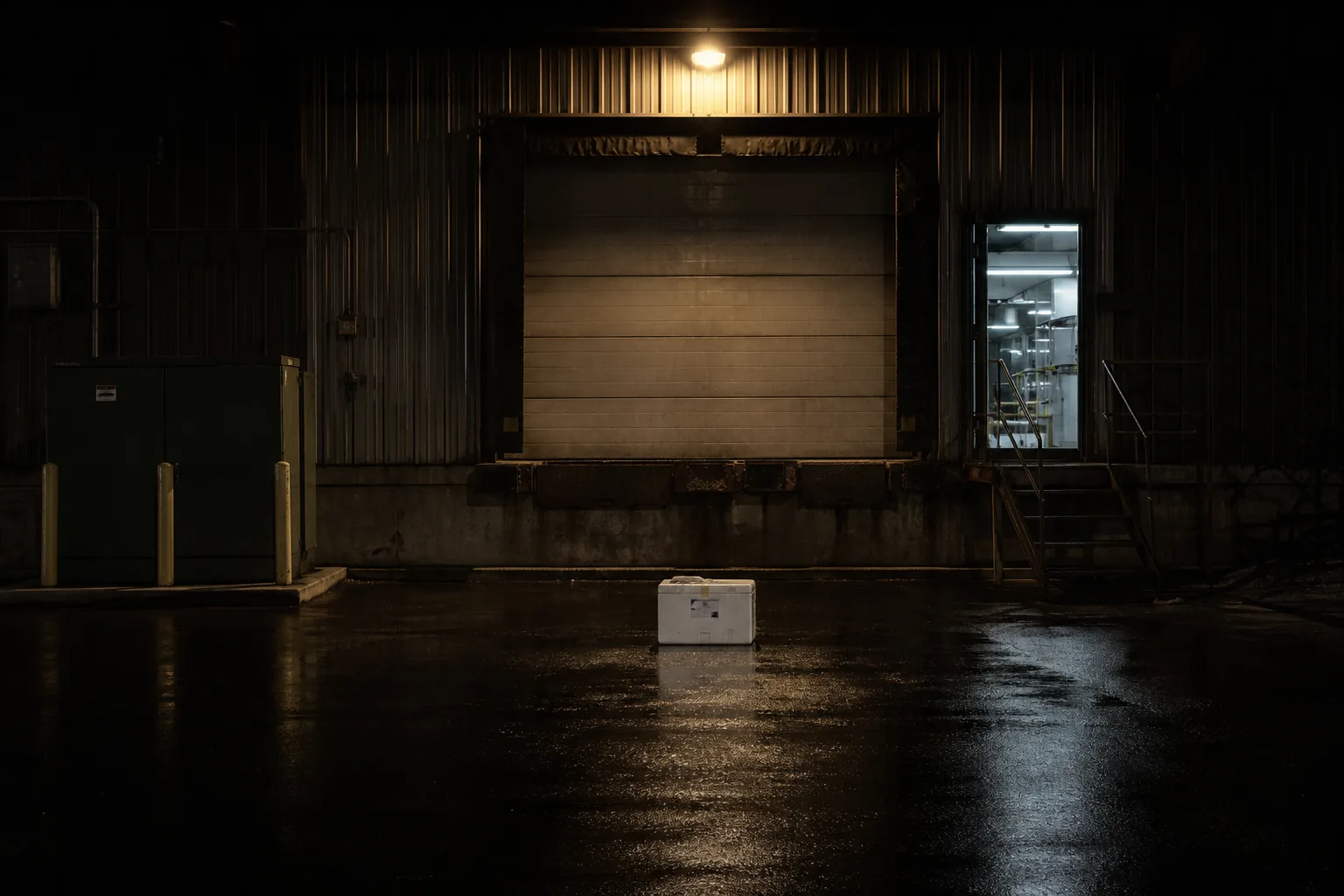
A small white shipper comes off the linehaul cage before daylight has decided what it’s doing.
White, scuffed at the corners, a label sealed under clear tape, a logger blinking behind its little window. Somewhere inside it your refrigerated vaccine is supposed to stay between two and eight degrees. It has already crossed the long part of its journey, and that was the expensive part. It arrives with the cold still inside it and almost nothing left that looks like transport.
The station floor is warm by comparison. Carts knock along the concrete. A scanner wakes, chirps, goes quiet. Parcels turn up with their own addresses and their own histories and disappear into the day’s arrangement.
Yours has a lane, a season, a product, and a packaging configuration chosen before anybody knew which driver would take it down which street. The insulated container and its refrigerant charge were qualified for exactly that arrangement, commonly proved out by ISTA 7E-style temperature testing. The box knows none of that. It has a hold-time, and the hold-time has been running since somebody closed it.
You turn it over in your hands before it goes on the cart. No frost. No useful sound.
Your logger started before the seal went on, back when the product and the refrigerant were still on a packing bench under somebody else’s lights. It has been taking readings at its configured interval ever since, accurate to half a degree or better.
That’s why it was started then. A logger that begins at pickup can report a perfectly clean ride and say nothing at all about a warm wait beside a loading door.
“Keep it with the scan,” says the man moving the cart. “Not loose.”
You scan it, and the screen gives it a route position.
Your parcel has stopped being a shipment in transit. It’s one stop on a manifest now, sitting among addresses close enough together today to be called a route.
Nobody walks the driver through that order. It was solved against the stops that existed this morning, and it can be solved again against the day as the day changes. The streets get no vote in it.
Your driver comes through later with a handheld and a shelf map. She finds your shipper by its route position, not by the word refrigerated.
The van door slides open on metal shelves and the enclosed smell of cardboard, coffee and wet coats. Your package goes in with everything else.
“It has a window,” you say.
She looks at the label without touching it. “Everything has a window.”
That isn’t carelessness, and you work out why on the way back inside. The packaging was selected for the product, the lane and the season, because every decision downstream has to fit inside a duration it already proved it could hold. A missed connection spends it. A station delay spends it. A stop sequence spends it one address at a time. Your route is not a refrigerator with a destination attached. It’s a solved sequence with a product inside it that can’t argue.
The van leaves and you follow it on the station screen for a while, a small icon turning through streets you don’t know.
The day rearranges itself around roads and traffic and collections and stops that run long. Sequencing gets recalculated against the actual list, and that’s the entire point of it. A driver has no fixed little kingdom of doors. The sequence gets built again each day because the work is different each day, even where the streets stay exactly where they were.
At your address, she takes the shipper off the shelf and crosses a lobby where the lights have been on since morning.
She presses the call button. Nothing.
She tries the outer door. Locked. There’s a printed sign beside the intercom saying deliveries by appointment, and there’s no appointment anywhere in the scanner. She calls the number on your delivery instruction. It rings until it stops.
Then she looks at your package, at the door, at the handheld. There’s no temperature emergency written into your stop anywhere. There’s access, and there’s proof.
If your parcel reaches the door, a signature or a geotagged photo might close it, depending which service somebody selected for you months ago. A date, a time, a picture, a name, a scanner event — that’s the whole difference between carried and delivered.
“No access,” she says into the handheld.
The scanner takes the words and your stop changes shape. Not delivered. Not lost. A failed attempt with its own timestamp, the same kind of record Signature Confirmation keeps when nobody receives an item.
Whether a notice gets left, and how redelivery is handled, depends on the carrier and the service. None of that is universal, and nobody standing at that door can tell you which version you have.
She walks back to the van carrying the box she carried in. Nothing has happened to it that anybody standing in that lobby could see.
Your hold-time continued the entire time.
Back at the station your failed shipper sits apart from the ordinary returns. The cart has a place for it. The screen has a word for it. The product inside has no opinion about either.
Your logger is still taking its readings, preserving the pause exactly as faithfully as it preserved the linehaul. It doesn’t know which part of your day was a failure. It knows temperature and it knows time.
Tomorrow’s route isn’t today’s route resumed, either. It’s another list, solved again against another day’s stops.
Redelivery sends your parcel out as a carried-over stop, so a locked door has turned a doorstep delivery into station dwell, a second loading, another van shelf, and another chance for a delivery proof to close the record. Your qualified container is still doing its job. It’s also now doing considerably more job than anybody asked it to.
Some parcels never take that branch. Their service has a fallback already set — a locker, or a staffed counter — and carrier policy can also send an eligible missed delivery to a pickup point. What’s actually available depends on the carrier and the service. The system either has that exit or it doesn’t.
Yours has it.
The next scan sends it to a fixed pickup point instead of another uncertain door, and it joins other parcels bound for the same place.
That’s why a locker changes the shape of the work. On a normal route a driver visits addresses one at a time. At a locker the driver delivers to the location and the recipients come later, separately, on their own time.
Your parcel has stopped gambling on a door.
The counter attendant signs for your box. The scanner takes the time. The carrier now has a completed delivery event, which is the record somebody will go looking for if the handoff is ever questioned. The product has not been accepted by the pharmacy. Your last-mile record only says where the carrier left it.
It is not the temperature record. Those are two different proofs, built for two different people, and you’re about to watch the second one disagree with the first.
At receipt somebody cuts your seal and takes out the logger. The display sits inside the two-to-eight band, and for a second everyone near the counter relaxes.
That’s the part that looks simple from a doorway. The package arrives cold. The package is fine. It isn’t fine because the display is fine. The display is one reading.
Your record starts before the package was sealed and runs through packing, carrier pickup, linehaul, station dwell, a locked door, a return to the station, and a locker delivery. EU Good Distribution Practice asks the supplying party to demonstrate compliance with storage conditions throughout distribution. Throughout is the word that makes the screen necessary.
The receiver downloads it and a line appears across your day, its points separated by the logger’s configured interval. Most of them sit where they should.
One part rises. It doesn’t need to rise far to matter. It only needs to be outside the approved range, for a duration the record can show. Nobody throws your product away. Nobody puts it into stock either.
Your shipper goes into a hold, because an excursion is a branch and not a verdict. The exact temperature, the time outside range, and the product’s own stability data have to meet somewhere much quieter than this counter, with ICH Q1A(R2) and the accelerated-stability work that was done long before your parcel existed. The result can be release. The result can be rejection. The logger decides neither. It only refuses to let the failed hour disappear.
You watch the receiver close the cabinet. The logger is still on the counter, a small plastic witness with nothing theatrical to say. Your shipper had the cold at arrival. It had a delivery record. It had proof a driver reached a place somebody could receive it.
Not one of those proved the trip.
The recording starts before the box is sealed rather than when the carrier takes it. That one choice, made by a person who has never seen this station, is the only reason anybody can see the hour in the lobby.
The station is already loading tomorrow’s routes. Stops become a sequence. The carts move. Somewhere a driver is pressing another call button, and somewhere else an insulated box is quietly spending time it was qualified to have.
Check the record
Sources
- Test Procedures — International Safe Transit AssociationAccessed 2026-08-18
- 2013/C 343/01: Guidelines on Good Distribution Practice of medicinal products for human useAccessed 2026-08-18
- Adding Extra Services — USPS Postal ExplorerAccessed 2026-08-18
- Change a Delivery — UPSAccessed 2026-08-18
- Controlled Temperature Chain — World Health OrganizationAccessed 2026-08-18
- Q1A(R2): Stability Testing of New Drug Substances and Products — ICHAccessed 2026-08-18
- Impact of Severe Weather Conditions on Biological Products — FDAAccessed 2026-08-18
- Research: Why So Many Packages Don’t Get Delivered — Harvard Business ReviewAccessed 2026-08-18
- Fixing Failed Deliveries — LoqateAccessed 2026-08-18