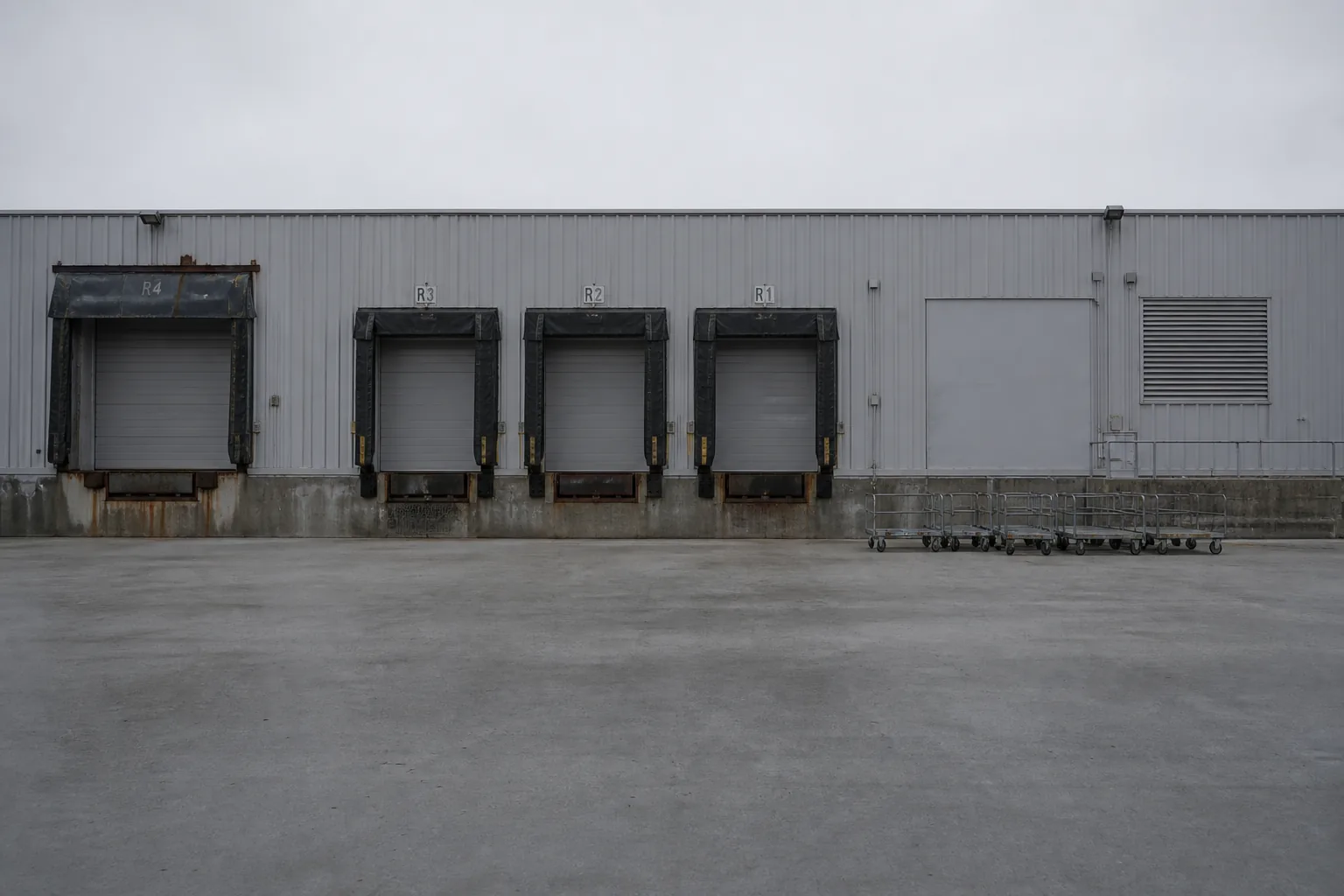
A returns door stands open beside the ordinary receiving doors, and that is how the mistake starts.
A trailer has backed in somewhere past the yellow posts. Cardboard comes down the conveyor in a bland, steady procession. Those ordinary cartons have purchase orders waiting on them, an ASN somewhere in the system, item lines already expected, and a place that can be named before anybody’s opened them.
Your return sits on a low cart with a carrier label scarred by old tape.
The box is smaller than the cartons beside it and worse for having been somewhere else.
A scanner reads it once. The carrier handoff closes. The building knows it has arrived.
“That’s it, then,” you say.
“That’s not the receipt,” the receiver says.
There is an RA number under the new label, and it was printed before the box started moving back toward you.
It came out of an authorisation step, not off your dock. Somewhere a portal or a marketplace flow or a call centre asked whether the original order sat inside its return window, whether the category allowed it, whether the stated reason belonged to a covered code. Mail-back, pickup or drop-off were all settled before your box became a physical inconvenience on a cart.
“Find the RA,” the receiver says. “Then it’s ours.”
The ordinary receipt goes first, because it’s built to go first. You scan the carton licence plate — often an SSCC barcode — and the screen asks it to agree with the ASN on item, quantity and lot.
The carton says what the system expected it to say. When a notice was sent ahead, that’s most of your work. The dock was scheduled. Equipment and people were put where the notice said a trailer would be, and nothing has to become a mystery at the threshold.
The next carton disagrees, and you stop it without any drama at all. It takes a discrepancy record, a reason code, photographs, and a trip to separate staging while purchasing or the carrier gets told. It does not earn a rack location by being present. Neither will yours.
A third carton is clean and simply moves on. Reconciliation and inspection clear it, a directed-putaway task appears, and you scan the item and then scan the destination location. It’s available-to-pick inventory only after that second scan says the first one has a home.
On the screen above the desk, a best-in-class dock-to-stock figure sits under three and a half hours, measuring a shipment from dock arrival to confirmed putaway.
It’s an excellent number for cartons that were promised a location before they arrived. It’s got nothing whatever to say about the box at your feet.
One ordinary receipt doesn’t even wait for a rack. The screen sends it straight to outbound staging, because a known and already-open order is waiting on it. Cross-docking is a short path with a destination at the end of it — storage bypassed because somebody’s already asked for this exact thing.
You look at your return’s closed flaps. No open order. No confirmed condition. No right at all to borrow the ordinary carton’s path.
The receiver finds the RA number and scans it, and that is the other receipt, the reverse-logistics one. It might happen minutes after the carrier scan in the building you’re standing in. It might happen in a dedicated returns centre after units have been consolidated out of several fulfilment nodes.
Either way, this is where your unit leaves the inbound returns queue and becomes available for inspection. The carrier handoff is finished. The grading queue owns it now, and so do you.
She rolls your cart away from the doors.
Nobody calls it stock. Nobody calls it processed. Those words are being held back until they can survive somebody checking them.
The grading stations sit behind a mesh partition where the light is whiter and the cartons are open.
There are two questions here, they aren’t the same question, and Amara at the second bench won’t let you collapse them.
The first is functional. Does your device power on, hold charge, pass its diagnostic? Does the appliance run its cycle? A machine can answer that for you with a screen, a cable, a sound from inside its own case. The answer may well be yes. It’s never the whole grade.
The second question is physical and complete. Is the packaging intact? Are the accessories and manuals in your box? On apparel, are the tags attached and unworn? On furniture, is there structural damage a delivery crew’s going to find later, in somebody’s hallway?
“A returned appliance can run perfectly and be missing its installation hardware,” Amara says. “That’s not new inventory because we need it to be.”
She turns your box over and reads the RA number again. The handheld takes the tier as she assigns it, so the grade and the return record change in the same motion. The code isn’t an opinion written on cardboard. It’s the next instruction starting to form.
Your unit is an electronic device.
It starts. The battery holds. The screen is uncracked. For a moment it looks to you as though the cart at the receiving door was being unreasonable about it.
Then she connects it to the wipe station.
Anything that stored personal data needs data sanitisation appropriate to the device before it can be regraded as resellable. It doesn’t cross back into sellable inventory just because its test passed. It has to forget the last owner before anybody can imagine the next one. That’s one reason electronics grade more slowly than apparel. The extra work never showed from the dock and it’s still in your box.
The screen records a completed wipe. Amara checks the charger and the manual against the return record, and a condition tier settles onto the RA. Now the building can finally ask you the question it wasn’t allowed to ask at receipt. What’s this worth after the work it needs?
There are five exits. Resell. Refurbish. Liquidate. Recycle. Dispose.
“Five,” she says, without looking up. “Not one way back.”
The highest tiers go to sellable inventory as new or open-box, at or near the original price. That’s resell, and it’s the exit your dock always wants to see, because it looks like a correction. Your dock doesn’t get to choose it. A tier with no functional issue and nothing missing earns it. A receipt scan never has.
The next unit needs cleaning, repackaging, a component replaced, a repair. It goes to refurbish, then out through a recommerce channel rather than primary retail. That product didn’t fail. The first channel did, and telling those two apart is where your recovery work actually begins.
Another waits with others like it, stacked for a secondary buyer. Liquidation moves bulk lots, often a pallet or a truckload, at a wholesale fraction of original retail with no further processing by the original seller. It sounds final until a trailer opens somewhere else, and then it’s simply a different market accepting a different grade.
The bottom two exits don’t pretend to be each other. Recycle means the product has no functional resale value while its materials still have some. Dispose means it clears none of the other channels and gets destroyed or landfilled. That distinction isn’t decorative. Landfill diversion counts every unit that finds any exit other than the last one.
The routing engine reads the condition tier, the category, current demand and estimated cost-to-recover, and it gives the same grade the same route across every inspector and every shift.
Which is exactly why nobody at these benches improvises a bargain with your box.
Consistency is what stops a clean-looking return getting the generous answer, and stops a damaged one getting it after lunch.
There is a figure in the returns office that makes the five exits considerably less philosophical.
A reported average runs twenty-six dollars fifty to process every hundred dollars of returned merchandise. Call it a twenty-six and a half percent cost load across authorisation, receipt, grading and disposition. Recovery rate sits next to it — value recovered across the channels, measured against original retail.
Neither number means anything on its own.
A high recovery gets eaten by the work you needed to reach it, and that arithmetic is the whole job.
The return rate is posted somewhere else, where it cannot make anybody hurry. Around fourteen and a half percent across channels in a recent year, near eighteen for e-commerce, ten for brick-and-mortar once you set aside buy-online-return-in-store traffic.
Those figures describe what came back. They say nothing about whether your box should be rushed toward resale, and your floor has a narrower question in front of it than the head office does.
Your wiped device leaves the bench on a cart marked for open-box inventory. It earned that exit.
An unopened return beside it hasn’t earned anything yet. Its RA is still waiting on test-and-grade, its five exits closed and equal and worth exactly the same amount of nothing.
A box coming back needs a second receipt under a different name. That rule is the only thing stopping a scarred carton walking into your stock behind a clean one.
At the receiving doors another ordinary carton scans against its ASN and goes off toward a location, because the system is quick wherever it has permission to be quick. Your return does not go back. It goes forward, into the decision that tells it where it is allowed to go.
Check the record
Sources
- Oracle: Return Material AuthorizationAccessed 2026-08-18
- Oracle: Cross DockingAccessed 2026-08-18
- GS1 US: Food Industry Guidance for Streamlining Your Logistics LabelsAccessed 2026-08-18
- NIST SP 800-88 Rev. 2: Guidelines for Media SanitizationAccessed 2026-08-18
- Optoro: The State of Returns 2024Accessed 2026-08-18
- WERC DC Measures Survey 2025Accessed 2026-08-18
- EPA: Electronics Basic Information, Research, and InitiativesAccessed 2026-08-18