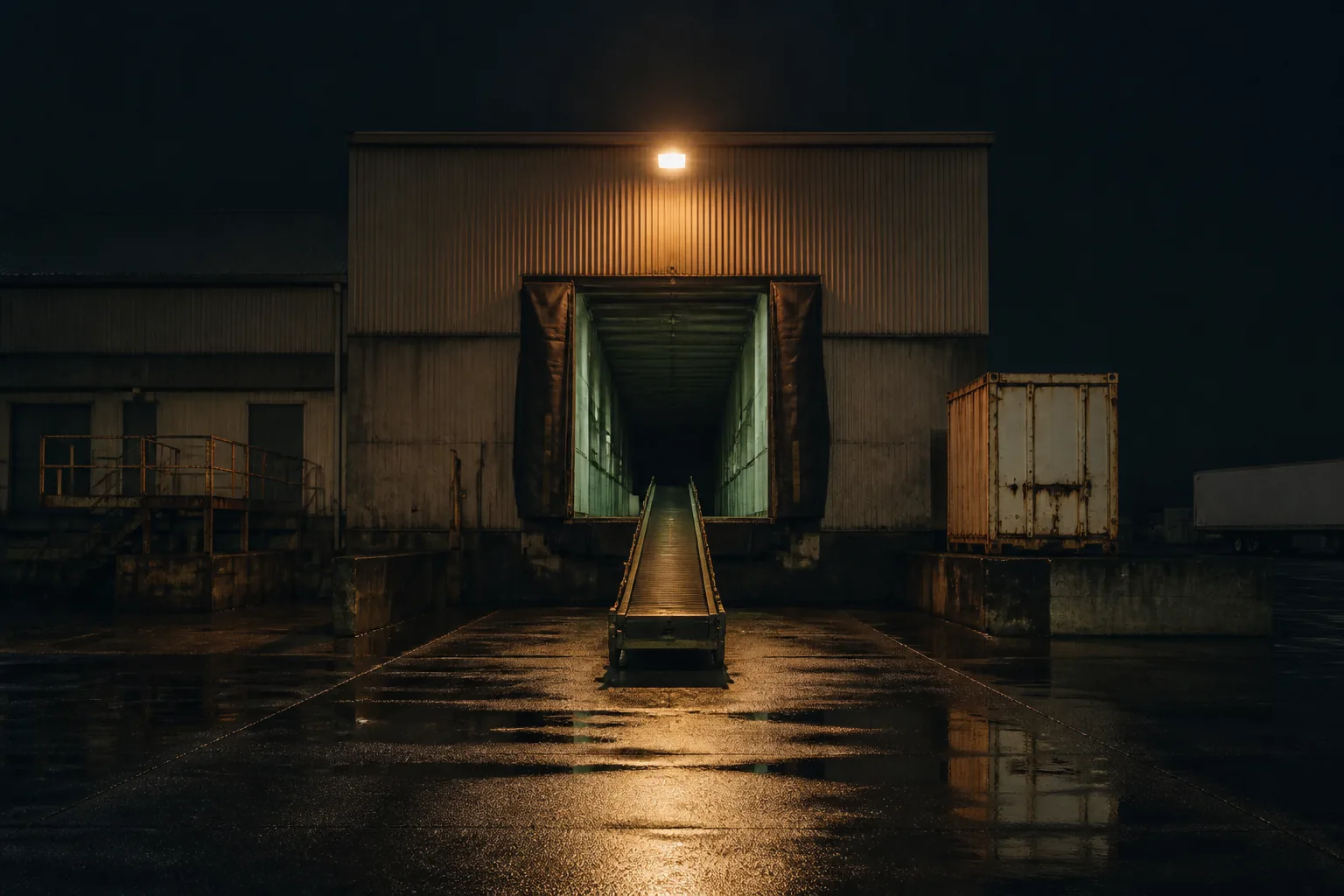
The tote reaches your pack station with its lid bowed and a strip of paper tucked under the handle. It came off a cart that crossed more of this building than you can see from where you’re standing. Beside you the cartons stand open in descending sizes, and past the guard rail an outbound trailer waits with its doors open and its floor dark from here.
Marisol runs the pack line. She hands you a tape gun and no explanation, which is the explanation.
“Where’d this start?”
“In the tote,” you say.
“It started three hours ago in a computer that’s never seen a tote.”
The order arrived as an EDI 940, a Warehouse Shipping Order, sent from the ERP that holds the order and the financial record.
It carried the order reference, the line items, the quantities, the destination and the handling instructions into the WMS. Nothing had moved yet. The message you’re holding the end of wasn’t a package. It was an instruction that a package would have to become.
Before that release turned into work, the system had already read it. Line count. Unit count. Ship-to type, residential parcel address or commercial dock. Service commitment, standard or expedited or same-day.
A single-line consumer order goes toward batch picking and parcel packing. A multi-line commercial order goes toward case or pallet picking and freight consolidation. Your tote is on your bench because those decisions finished arguing with each other before you came on shift.
“So it waits,” you say.
“It waits in a queue until a wave takes it.”
A wave isn’t a convenient pile. It’s a group of orders released together because a carrier pickup or a dock departure is coming, and your picking and packing and staging all have to finish before it does. Several waves run through your shift, and in an ecommerce-oriented micro-fulfilment operation five hundred to two thousand orders can pass through a day’s waves.
Size a wave wrong and you get one of two failures. You stand around between waves. Or your work stands around waiting for a departure it has already missed.
“Can I push this one to the next wave?”
“No.”
“If it’s short a—”
“No. Once it’s released it’s locked to its wave unless somebody overrides it by hand.” She’s already moving. “Otherwise you get a tote half-picked and abandoned by the order it belongs to.”
On the screen by the tape dispenser your wave is a count and a status. On the floor it’s carts, paper, plastic, feet, and the low hard sound of work that was scheduled before you arrived.
Nobody ever handed one person this whole order and asked them to go find the pieces.
The WMS broke your release into directed tasks. A pick task names a location, a quantity, and a unit of work. You take it on a handheld RF scanner or a voice terminal, walk where the system sends you, and confirm the location barcode, the item or licence plate, and the quantity.
Until that scan, the task is only what the WMS predicted. At the scan, the location and quantity record becomes the record of what happened.
“That’s why you don’t skip one,” Marisol says. “Ever.”
Skip a confirmation and the WMS keeps holding the old location and quantity while you have already gone somewhere else. Mis-scan and you’ve made a record clean enough to travel and wrong enough to matter in about nine days. Your tote got this far because every earlier task was confirmed. Or because somebody walked back and found the exact point where it wasn’t.
Some of those tasks came through the high-velocity lane in batch, one picker moving through once, filling separated totes with several orders’ single-line demand. Some ran through zones, your tote handed from one fixed section of floor to the next. Discrete picking would have sent you through the whole order yourself — slow in travel, simple in everything else. Cluster picking would have put several totes on your cart and sorted at the pick instead of afterward. This building runs a hybrid, because a building has no reason to prefer a clean theory to the work actually in front of it.
Your route changes while you’re walking it, too. When you close a task, the WMS can see a replenishment or a putaway sitting near your return path and drop it in. That’s task interleaving. It isn’t a route written at the start of a shift — the system re-reads your position, the pending work and the layout in real time, trying to stop you walking back empty-handed.
Depending on task mix and layout, the reported productivity gain runs from ten to forty percent. Nobody at the cart calls it a gain. They call it the next instruction.
You lift the lid. There are items in there from more than one zone, each with the small silence of something that has finally found the other things it was meant to travel with.
You verify them against the pick list, and that’s the order check. If the tote drew from more than one zone, this is where it becomes one order again.
“A missing item isn’t fixed by a neat carton,” Marisol says. “A wrong item isn’t made right because your tape held.”
Your carton has to fit what’s actually there. Cartonisation means picking the smallest box or mailer that does, with dunnage where the contents need it. This is the stage where the shape of your package reaches forward into the carrier’s charge, because dimensional weight will be billed against it.
In outsourced fulfilment, pick-and-pack work can run anywhere from twenty cents to five dollars an item, depending on size, fragility and packaging. Your tape gun doesn’t know any of that. The rate finds out later.
You close the carton and bring it to the terminal, where it takes a tracking number, a carrier and a service level. Those three things make the shipping manifest. Your order is packed now. It hasn’t crossed the seam.
It’s staged beside the conveyor, in the last place where a barcode can still be rejected and a carton can still become an exception, and where the carrier hasn’t yet taken anything anywhere.
The man at the next station barely looks at your carton. He looks at the screen and the label, and makes the scan you didn’t make.
The scanner answers in the same small voice it’s used all day. The shipping record changes. The carton goes onto the conveyor, under the work light, into the trailer’s shadow, and out of the warehouse’s ordinary field of correction.
“Ship confirm,” he says.
The phrase is flat because it has to be. The WMS now holds a confirmed outcome against your release, and it checks the wave — every order has to have shipped or been flagged as an exception before your wave can close.
Yours shipped. The manifest was its route and its name for the carrier. The confirmation is the event that lets it leave the warehouse record as work still being directed.
Then a message goes back the other way. An EDI 945, the Warehouse Shipping Advice, telling the ERP what actually shipped, in what quantity, against which release.
“That’s the 940 coming home,” you say.
“That’s not the 940.” She takes the tape gun off you. “The 940 asked for work. The 945 reports what happened. If those two were the same message you wouldn’t need either one.”
At that moment the ERP can change the order status and move the inventory value on its books. A system becomes honest exactly here, where you’re standing — by admitting the distance between what it was told to do and what it can prove it did. That distance fits inside a tote and can still stop everything. Your release asked for a hundred units. The 945 confirms ninety-four.
The confirmation doesn’t say why. It might be a putaway scan, a cycle-count miss, an item-master problem, or some other break between the record and the floor.
But it’s visible now, and that’s the whole point of the event. Before confirmation, six units could hide inside intention. After confirmation, they have a number and a direction to walk back upstream.
The conveyor pulls your carton past the last pack station.
The carrier’s dock crew will take it with the day’s other manifested work, its tracking number already attached to an order somebody has been refreshing on a phone. Everything that reaches that person later started as a number on this terminal. What ended at that scan wasn’t movement. It was authority.
One message asks and a separate message answers, with a scan standing between them. That scan is the only place in this entire building where the record and the floor are required to agree.
Behind you another tote arrives. Somewhere a 940 is being broken into a location, a quantity and a task. Another wave is holding its orders together against the next departure.
Marisol is already looking past you at the queue. The wave ends at ship confirm, and the carrier’s clock starts there, and yours starts again with the tote at your elbow.
Check the record
Sources
- 940 — Warehouse Shipping OrderAccessed 2026-08-18
- 945 — Warehouse Shipping AdviceAccessed 2026-08-18
- Oracle Warehouse Management Implementation GuideAccessed 2026-08-18
- ASCM Supply Chain Dictionary, 18th editionAccessed 2026-08-18
- Oracle Warehouse Management — Zone PickingAccessed 2026-08-18
- Oracle Warehouse Management — Pick CartAccessed 2026-08-18
- Oracle Warehouse Management — Streamline Inventory Picking with Enhanced SKU Scanning OptionsAccessed 2026-08-18
- Oracle Warehouse Management Implementation Guide — CartonizationAccessed 2026-08-18
- UPS — Shipping Dimensions and WeightAccessed 2026-08-18
- Oracle Warehouse Management — Parcel Manifest ConfigurationAccessed 2026-08-18
- Advanced Warehouse Technologies — Perspectives and PossibilitiesAccessed 2026-08-18
- Micro Fulfillment Centers: The Complete Guide to Ultra-Fast eCommerce DeliveryAccessed 2026-08-18
- Fulfillment Costs: How to Calculate FeesAccessed 2026-08-18