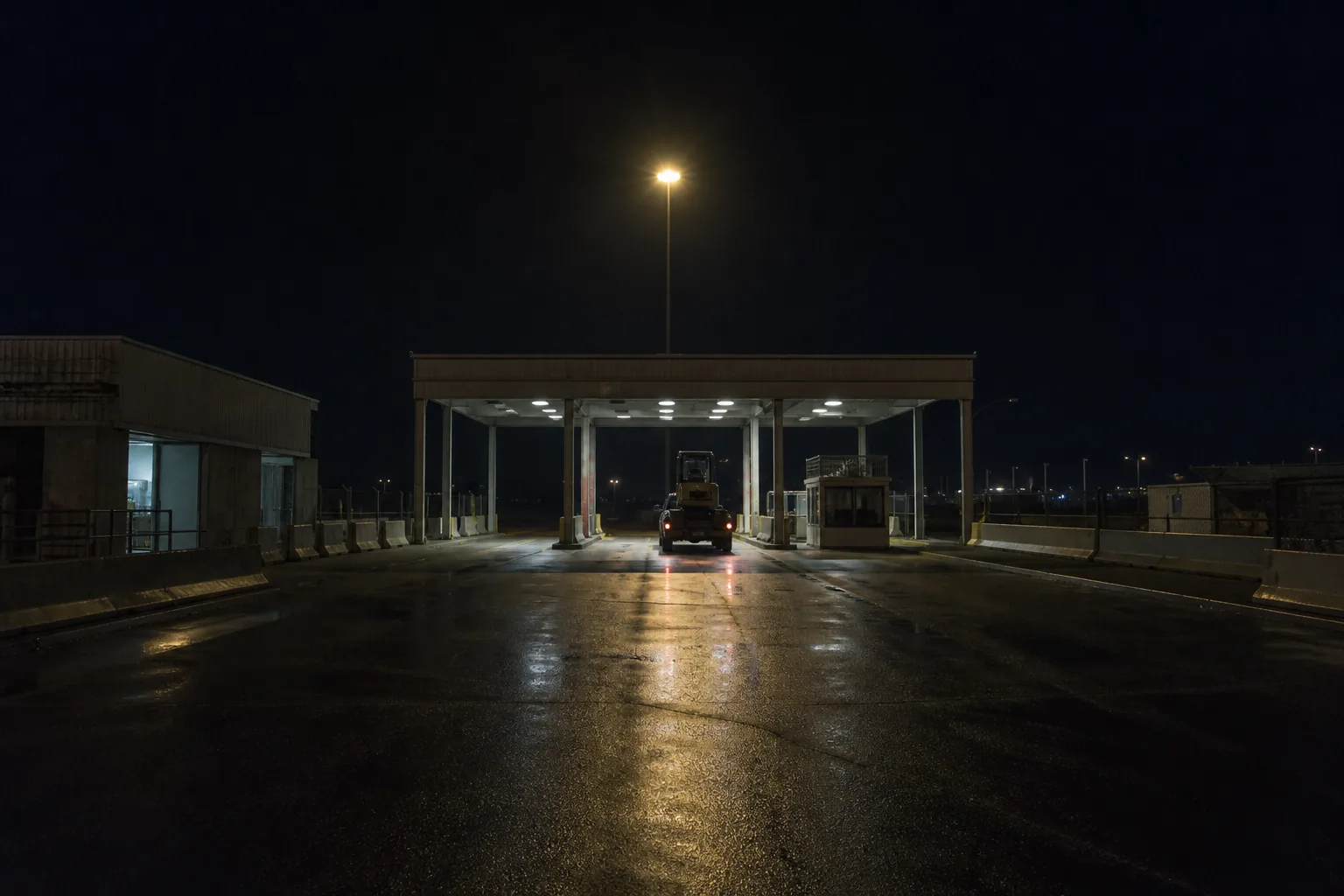
Your pickup looks ordinary from behind. A dually’s wide hips, a tool chest behind the cab, mud dried into the seams of the tailgate. The trailer carries the equipment that made the trip necessary.
You know the truck is a Class 3, because its own rating runs somewhere around twelve to fourteen thousand pounds. You’ve seen trucks like it at hardware stores and beside feed sheds your whole life.
You have never once added the trailer to it.
The passenger line moves beside you in short bright pieces. Windshield, face, barrier arm, gone. Ahead of that, the commercial plaza collects trailers under its own lights.
At Mariposa in Nogales, CBP lists thirteen passenger-vehicle lanes and eight commercial ones. Those numbers are painted into the design. They are not a promise about this hour.
An officer stands where the two streams divide. He looks at your Class 3 pickup, then at the heavy equipment trailer, then at the paper in your hand.
He does not look remotely impressed by how little your truck resembles a tractor.
“Combination weight?”
You find it. The truck hasn’t gained a pound since it left the yard. The combination has reached twenty-six thousand and one pounds gross combination weight rating, with a trailer rated above ten thousand. That is the number that changes the conversation in commercial operation.
A Class 3 dually can sit under the CDL weight test on its own and still meet the federal Class A test once a heavy equipment trailer is behind it. It can trigger a CDL requirement without ever acquiring a sleeper, a fifth wheel, or any of the appearance people expect a rule like that to have.
He points past the passenger booths.
“Commercial. Keep right.”
That’s the whole conversation. The lane isn’t yours to pick because your Class 3 pickup looks like something you drive home at weekends. The authority has decided what this combination is for the next piece of ground. You turn right. The passenger line keeps moving beside you, close enough to make the wait feel personal.
Those eight commercial lanes are nominal design capacity, too. In a shared plaza, CBP and Mexican customs can open additional passenger lanes through peak crossing hours. A lane count is a hard thing on a plan and a much softer thing at the cones. The officer with the gesture is the capacity calculation you actually meet.
Ahead of you a farm plate sits on the back of a grain truck, the driver’s window down.
He’s explaining something to the first booth and you catch pieces of it. Owner. Farm. Not for hire. Every one of those words has conditions standing behind it.
A covered farm vehicle can be released from CDL, drug-and-alcohol testing, hours-of-service and several other federal motor-carrier rules — when the farm owner, a family member or an employee is operating it, when the state identifies it as a farm vehicle, and when it’s carrying agricultural commodities, livestock, machinery or supplies to or from a farm or ranch rather than for hire.
The truck does not become lighter while he says any of that. A Class 8 grain truck is still a Class 8 grain truck.
The exemption changes the licensing consequence for exactly as long as its conditions hold. A state may also grant a narrower farmer waiver to an individual driver, which is a different question with a different boundary drawn around it. Neither one turns a weight label into a different weight label.
The booth light changes and the grain truck moves. A motorhome takes its place in the next lane, polished to the point of refusing dust.
It may carry a rating above twenty-six thousand pounds, in the Class 7 or Class 8 band, and still generally sit outside the federal CDL rule while it’s privately owned and used for personal travel. Federal CDL rules concern commercial motor vehicles operated in commerce. A state can add its own non-commercial licensing rule on top. The curtains in the window settle nothing. The jurisdiction does.
You pull into the inspection bay and kill the engine. Your trailer ticks in the heat.
The officer asks for the certification label and its rating before he asks what your equipment is for.
Beside the bay there’s a chassis-cab truck waiting, its frame carrying a bucket body that arrived long after the cab and frame did. It’s here for the same reason the motorhome was here. The name on the grille has stopped being a sufficient answer to anything.
A chassis cab can become a dump truck, a mixer or a bucket truck after the original maker releases it. The final-stage manufacturer — the body builder or the upfitter — may assign or reduce the originally listed rating.
The certification label that governs belongs to whoever completed the last stage. Two identical chassis can leave with different final ratings, different bodies, different axle specifications and different classes.
“The first label was an offer,” the officer says. “I read the finished one.”
You hand yours over and he reads it in the bad light inside the door jamb. There’s no debate in the way he holds the plate.
A vocational truck’s own weight was never the number that sounded likely when somebody said its model name. It’s the number on the completed unit, and nothing else has ever been the number.
Beyond the fence a hostler drags a trailer from one marked slot to another.
Square blunt cab, a spotter, built on a Class 8 chassis. It can move heavy trailers all day inside a distribution centre and avoid most on-road licensing and inspection rules, because it never touches a public roadway.
The FHWA class table and the CDL rule both assume a vehicle will meet public road somewhere. That hostler has built an entire working life out of not doing it. It isn’t invited through this plaza. The public road starts before the booth, and the road is what changes the Class 8 question.
There are other answers to questions people ask with their eyes. A fire engine or aerial apparatus can be Class 8, commonly well past thirty-three thousand pounds once tank and pump and ladder are on, while its drivers move through federal exemption language and state emergency licensing. A refuse truck can be Class 7 or 8 with a driver on modified CDL testing or a state waiver, because short low-speed collection routes are not the long-haul combination task the skills test was imagining.
Then a school bus comes round the far end of the plaza, short enough to make a person careless about it.
Designed for sixteen or more passengers including the driver, and it needs a CDL. Class C where it meets neither the Class A nor the Class B weight test, Class B or Class A where those apply, with the passenger and school-bus endorsements attached.
The trigger is the seats. Not the rating.
A Class 4 or Class 5 short bus with fifteen children and a driver can demand the same licensing answer as a Class 8 vehicle. Weight was never the only line on this ground. It’s only the one you happened to drive into.
The officer hands your papers back.
“You go there,” he says, pointing at a line with trailers in it. “They go there.” The border hasn’t made your pickup bigger. It has made it legible to a different system.
That system has room for a farm truck under conditions, an RV under a purpose, a hostler only while it stays off the road, and a school bus because of the seats inside it. It’s under no obligation whatever to make any of that look sensible from where you’re sitting.
The commercial lane runs toward a second canopy, trucks waiting under it with their hoods pointed at the same barrier. In a shared plaza the count changes at the shift, at the traffic peak, at the discretion of people deciding which stream needs another opening. Eight lanes is design capacity. Your working lane is the one the authority gives you.
On a wall beside the office an old display names crossings as though a ranking could settle them, with the measures in smaller type underneath.
San Ysidro makes the problem plain. It ranks fourth among land crossings in the world by total vehicle-and-pedestrian volume, and it no longer processes truck crossings at all — those moved to Otay Mesa, six miles away, in the early nineteen-nineties.
Busiest isn’t a fact until somebody tells you busiest by what.
The display hasn’t yet worked out where to put the Gordie Howe International Bridge, which opened with six lanes of direct freeway-to-freeway capacity. The border-crossing data and the tidy rankings need a full year or more before they can compare anything.
Ambassador Bridge’s truck count had already fallen eleven percent in 2024, to one of its lowest levels since 2009, before Gordie Howe opened at all. A later figure needs a reference year before it’s allowed to claim a cause.
You need none of that to get through the next barrier. You need a lane assignment, a weight record, and the authority’s decision. You read the little dates under the ranking anyway. You read the measure.
Twenty-six thousand and one is a number a committee agreed on. Your truck has been two different vehicles ever since, depending which side of a painted line it is parked on.
By the time the barrier lifts you know your pickup didn’t change at the line. The question changed. And the question has always belonged to the person on the other side of it.
Check the record
Sources
- Commercial Driver's License: DriversAccessed 2026-08-18
- What is a Covered Farm Vehicle?Accessed 2026-08-18
- Linking FHWA and NHTSA Vehicle Types and Deciphering Various Truck Weight DataAccessed 2026-08-18
- NHTSA Interpretation: ColmanAccessed 2026-08-18
- CBP Border Wait TimesAccessed 2026-08-18
- BTS Border Crossing/Entry Data FAQAccessed 2026-08-18
- Celebrating the Gordie Howe International BridgeAccessed 2026-08-18
- Detroit-Windsor Tunnel FAQsAccessed 2026-08-18
- February 14, 2022 Declaration of Public Order EmergencyAccessed 2026-08-18
- The Ambassador Bridge Has Lost Its Spot as the Busiest U.S.-Canada Trade CorridorAccessed 2026-08-18