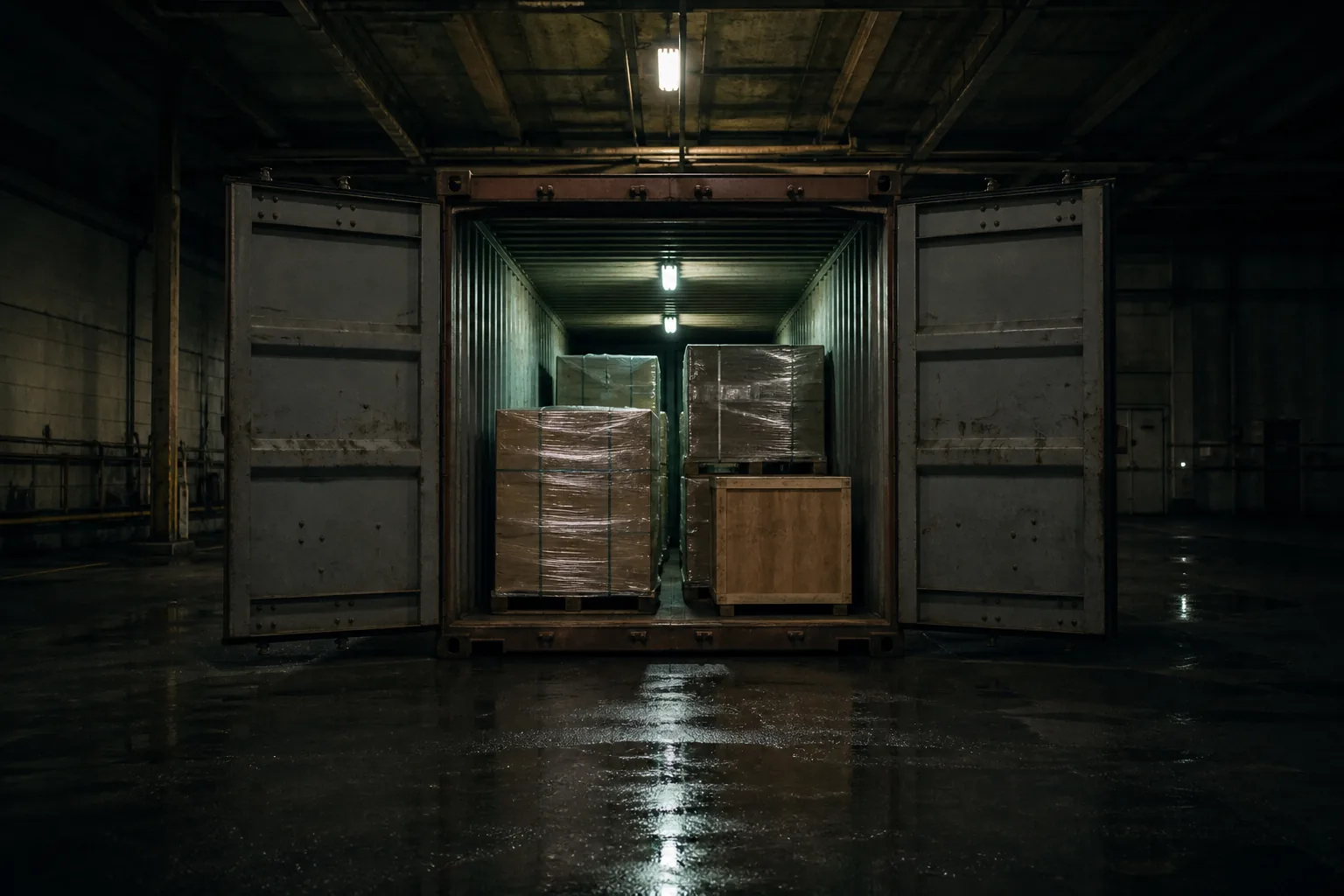
Your pallet is already wrapped when you meet it. Clear film pulling the corners tight, a label facing outward underneath another label, the wood dark where fork tines found it before.
It’s one of two. That isn’t enough cargo to ask for a container of its own. A twenty-foot box holds something like thirty-three cubic metres. Your cargo doesn’t need that much room. It needs a way to borrow it.
The origin container freight station is built for borrowed room. Forklifts come through the open doors carrying things that arrived on different invoices, from different shippers, with different instructions about who’s allowed to call for them at the other end. A man with a clipboard reads the marks on your pallet, then the marks on his paper. He doesn’t ask which ship it’ll see. That part belongs to somebody further along than him.
Your booking is LCL.
“Less than container load,” you say.
“Less than container load.” You know the phrase. It has always sounded to you like a small version of a container shipment — a container with the volume turned down.
Here it means something considerably more exact.
Your two pallets have been accepted by an NVOCC, and the NVOCC has given the shipper a house bill of lading. That’s the contract you can actually see.
It names the cargo.
It names the NVOCC as carrier. It carries the freight terms and the ports where the work is meant to start and finish. Somebody may use it to arrange payment against a letter of credit, and somebody at the other end will use it to claim the goods.
You hold it by its clean edge and understand for the first time that a bill can follow cargo without following all of it.
“Keep that number.” The clerk taps the house-bill reference with one nail. “Not the vessel number. This one.” She says it flat, the way you say a thing you’ve said before.
The house bill is yours. The shipper has no contract at all with the vessel operator, and typically never sees the document the vessel operator is going to issue. There’s no missing copy in your file. There’s another contract being written for another party.
At the back of the CFS the shared container waits with both doors open.
A twenty-footer, empty enough that its thirty-odd cubic metres look considerably larger than they did as a number on a booking screen. There’s cargo in it already — crates, wrapped pallets, a stack of cartons strapped to a frame — and every piece arrived under its own house bill.
The NVOCC doesn’t tell you whose cargo is going in beside yours. It has no reason to.
This is groupage. Five, ten, more house bills can become one container. Several LCL bookings become a single FCL booking, and the NVOCC buys that full-container-load carriage from the ocean carrier. The people who own all this cargo don’t become partners because their pallets touch in the dark. They stay separate claims inside one useful piece of steel.
Your pallet goes in after another pallet and before a wooden case with a number stencilled low on its side. The forks lower. The driver backs off. Somebody pulls the doors to and the seal clicks into the hasp.
From outside, all of it has become one container said to contain something. The ocean carrier will see one booking from one shipper of record, and that shipper is the NVOCC.
Under 46 CFR 515.2 an NVOCC is a common carrier that doesn’t operate the vessels providing the ocean transportation, and is a shipper in its relationship with the ocean common carrier. That doesn’t sound strange while the doors are open. Once the seal is closed it becomes the shape of the whole job. Carrier on one side of it. Shipper on the other.
Same organisation.
The ocean carrier issues a master bill of lading, and you will never see it.
The NVOCC is named on it as shipper. A destination agent, or the NVOCC’s own office, is named as consignee. It covers your twenty-foot container as one unit of cargo.
It doesn’t list the five or ten or more house bills that might be inside. It doesn’t want your house-bill number and wouldn’t know what to do with it.
The container leaves the CFS, then the terminal, then the part of the port that lets visitors think they know what’s happening. Its route, its vessel rotations and its schedule all belong to the carrier’s service network. Status updates reach you through the NVOCC, because that’s who you have.
The distinction stays quiet at sea. Nothing separates the two bills physically. They’re nested around the same sealed cargo, one contract sitting inside another. Somewhere a vessel operator holds a master bill. Somewhere else you hold a house bill. Neither one has ever been a substitute for the other.
At destination the container comes off the carrier’s side of the journey with its seal still closed.
There’s nothing on those doors identifying your two pallets from anybody else’s cargo.
The carrier checks the container against the master bill and hands the box to the NVOCC, its destination office, or whoever is receiving on its behalf. The carrier is finished with the master bill at that handoff. You are not finished.
Nobody has handed you anything.
This is where a shared box turns back into several claims. The NVOCC takes delivery under the master bill and moves the container to the destination CFS.
The master-bill obligation ended when the carrier gave the whole container over. It ended even with five or ten consignees still waiting for cargo inside it. That seal has crossed one legal boundary. It hasn’t come near yours.
The deconsolidator cuts it. The doors make their old metal sound and open onto the order somebody made at origin — one pallet in front of another, a case against the wall, cartons stacked above the line where a person could still reach them. The container was one shipment for the ocean carrier. At this CFS it becomes the separate portions it always was.
Your pallet comes out once the cargo in front of it has been moved. A worker reads the mark, scans it, and finds your house-bill reference in the destination file.
That’s the reconvergence, and it’s worth being precise about. Your cargo has lost the master bill’s invisibility. The master bill has not turned into the house bill because somebody opened the doors. The NVOCC still owes performance under your house bill until the named consignee receives that particular cargo.
“Which bill?” the warehouse clerk asks.
“The house bill.” “Say the number.”
You know the answer now. Not the one the ocean carrier used. Not the one that closed when the container changed hands. The house bill. The number you were told to keep.
The consignee’s agent brings a release instruction later, and it’s called a delivery order.
The page has cargo details, a name, and the practical force of somebody asking a warehouse to let a thing go. It looks close enough to a bill of lading that a person might call it one without thinking about it. At a counter, that’s exactly how a wrong word becomes a wrong expectation.
A delivery order authorises release.
It is not automatically a document of title. Under the common-law analysis carried into Uniform Commercial Code Article 7, the legal effect turns on whether the bailee holding the goods has attorned — formally accepted the instruction to hold or release goods for the named party.
The CFS doesn’t release your pallet because a piece of paper has an official-looking border on it. It releases when the instruction and the holding party have met in the way that’s required.
The clerk looks at the delivery order, then at the house bill, then at your pallet. Each one is answering a different question.
The house bill says which contract reaches this cargo. The delivery order says who’s authorised to take it. The master bill finished its work at a gate you never saw, and it’s still the document most people picture when they say the words bill of lading.
For a moment nothing moves. Your pallet sits on the forks under the CFS lights, a small part of a box that has stopped being a box. Then the clerk enters the release. The bailee accepts it. The door opens.
One steel container can hold ten separate contracts and be a single shipment at the same time. Every question you asked today was really a question about which of those two things you were standing in front of.
The truck outside is waiting for one pallet, not a container. The consignee receives cargo under your house bill, and that’s the moment the house-bill obligation ends. The master bill ended earlier, at the container handoff. Both bills followed your pallet across the same ocean. They simply stopped following it at different doors.
Check the record
Sources
- Federal Maritime Commission — Ocean Transportation IntermediariesAccessed 2026-08-18
- eCFR — 46 CFR § 515.2, DefinitionsAccessed 2026-08-18
- Hapag-Lloyd — 20' Standard container specificationsAccessed 2026-08-18
- Uniform Commercial Code § 7-102 — DefinitionsAccessed 2026-08-18
- Uniform Commercial Code § 7-502 — Rights acquired by due negotiationAccessed 2026-08-18
- Uniform Commercial Code § 7-503 — Document of title to goods defeated in certain casesAccessed 2026-08-18
- UN/EDIFACT D.15A Data Element 8335 — Movement type description codeAccessed 2026-09-18
- GOV.UK — Northern Ireland Retail Movement Scheme: groupage and mixed load consignmentsAccessed 2026-08-18